English
 Dutch
 French

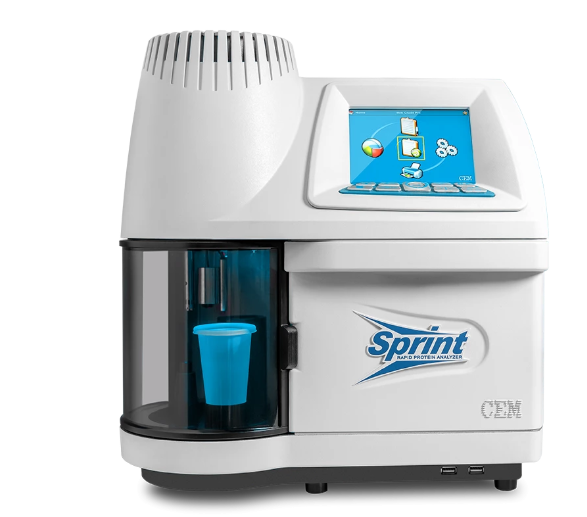
Rapid protein analyzer
The CEM Sprint Rapid Protein Analyzer provides fast, direct protein determination in food and dairy products. Using proprietary iTag protein-tagging technology, the instrument measures protein rather than total nitrogen. This approach distinguishes protein from non-protein nitrogen (NPN) and delivers results in less than five minutes.
Sprint offers an alternative to conventional Kjeldahl and combustion methods for suitable food applications. Its rapid analysis supports quality control, raw material evaluation, and production monitoring.
How does the Sprint protein analyzer work?
Unlike Kjeldahl and Dumas combustion methods, which determine protein indirectly from nitrogen content, Sprint measures protein through a chemical tagging reaction.
The system uses CEM’s proprietary iTag technology to bind a reagent to proteins in the sample. The analytical process involves several steps:
- A predetermined amount of iTag solution is added to the sample and homogenized to release the proteins.
- The iTag molecules bind to the proteins and are removed from the solution.
- The remaining unbound iTag passes through a disposable filter into the built-in colorimeter.
- The system determines the amount of iTag bound to the proteins and displays the protein result.
This approach enables direct protein analysis without relying on a nitrogen-to-protein conversion factor.
Direct protein analysis vs. Kjeldahl
Kjeldahl and Dumas methods measure nitrogen and calculate protein content using a conversion factor. However, some samples contain non-protein nitrogen compounds that can contribute to the measured nitrogen content.
Sprint uses protein-tagging chemistry to distinguish protein from non-protein nitrogen. This reduces interference from nitrogen-containing compounds such as melamine.
The following manufacturer data compares Sprint and Kjeldahl measurements in fluid milk containing added melamine:
| Sample | Kjeldahl Protein | Sprint Protein |
|---|---|---|
| Fluid milk | 3.3% | 3.3% |
| Fluid milk with 0.1% added melamine | 3.7% | 3.3% |
| Fluid milk with 0.5% added melamine | 5.1% | 3.3% |
| Fluid milk with 1.0% added melamine | 8.6% | 3.4% |
In these results, added melamine increases the apparent protein content determined by Kjeldahl. Sprint maintains approximately the same protein result across the tested samples.
These results illustrate the difference between nitrogen-based and direct protein measurement. They do not establish universal performance across every sample matrix or potential interferent.
Rapid protein determination without hazardous waste
Sprint uses non-toxic iTag solutions and does not generate hazardous waste during analysis. The system uses disposable sample cups and filters to simplify sample handling. After each measurement, Sprint automatically cleans its internal components. Operators can then discard the used sample materials.
This workflow reduces manual cleaning and avoids the concentrated acids required for conventional Kjeldahl digestion.
Simple operation and preprogrammed methods
Sprint combines automated analysis with preprogrammed methods for a wide range of food samples. Operators select the appropriate method, weigh the sample into a disposable cup, and place it in the instrument with a filter. Sprint then performs the analysis and displays the protein result.
The software can store hundreds of methods and tens of thousands of sample results. Downloadable iMethods are also available.
Protein analysis applications
Sprint features pre-programmed methods, including:
- Dairy products: fluid milk, milk powders, cheese, yogurt, cream, and whey
- Meat and poultry: beef, pork, chicken, turkey, and processed meat products
- Plant-based foods: soybeans, tofu, soy beverages, and hummus
- Other food products: eggs, wheat flour, infant formula, nutritional drinks, and prepared foods
- Pet food: wet pet food formulations
Applications and methods
Sprint exists for protein analysis in food and dairy applications. The system automates the following AOAC Official Methods:
- AOAC 967.12
- AOAC 930.33
- AOAC 930.29
- AOAC 2011.04