 English
 Dutch
 French

Moisture and solids analyzers
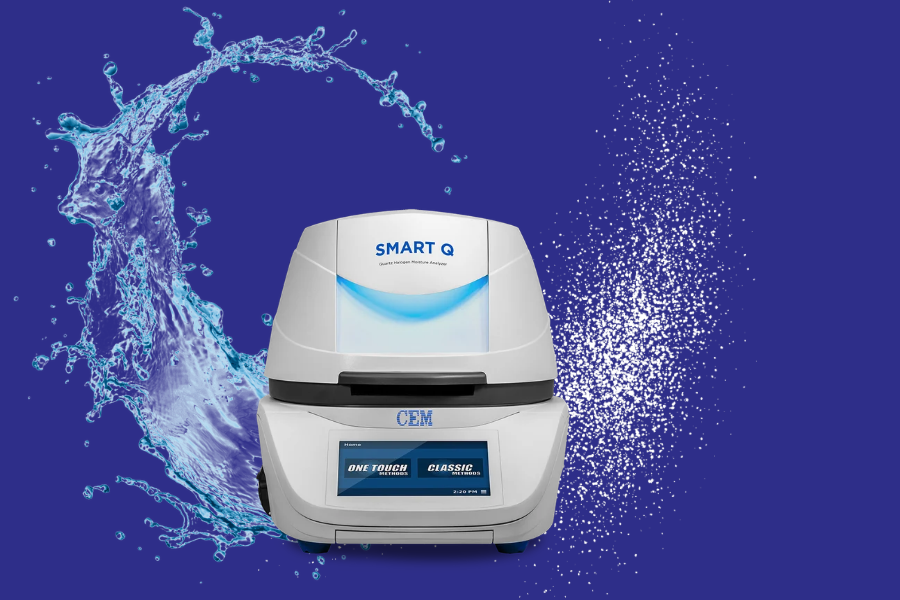
Moisture and solids analyzers determine the moisture or total-solids content of a sample through controlled drying and continuous weight measurement. These measurements support quality control, process monitoring, product development and incoming-material inspection.
What is moisture and solids analysis?
Moisture analysis determines how much water or other volatile material is removed from a sample under defined drying conditions. The result is generally reported as a percentage of the original sample mass.
Total-solids analysis determines the material remaining after drying. Moisture and total solids therefore describe two complementary parts of the same sample:
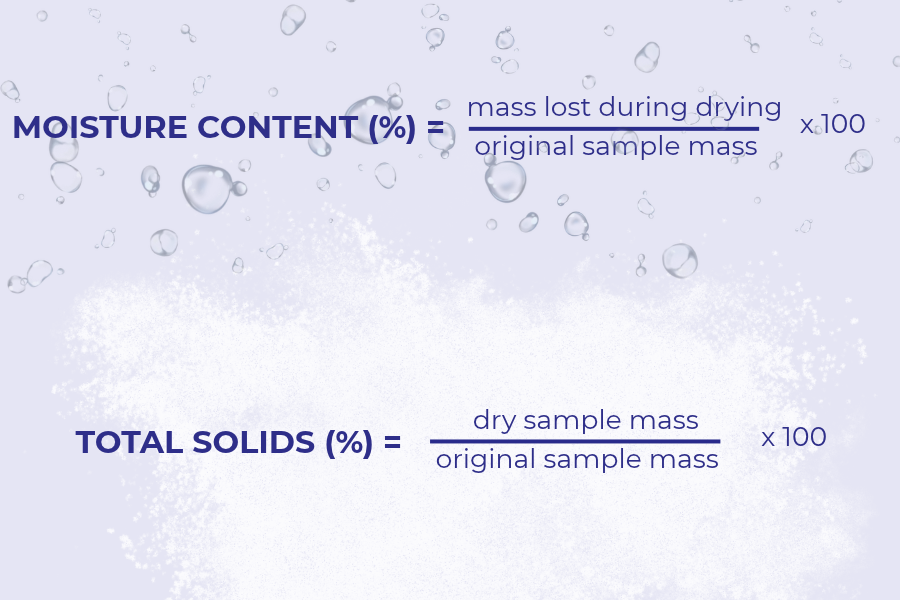
Moisture content (%) = mass lost during drying ÷ original sample mass × 100
Total solids (%) = dry sample mass ÷ original sample mass × 100
For methods in which the measured mass loss is attributed entirely to moisture, the two results add up to 100%.
Moisture and solids content can affect product quality, stability, texture, processing behaviour and commercial value. Rapid determination helps laboratories and production teams make timely decisions without waiting for conventional oven-drying results.
Moisture content versus total-solids content
Moisture content represents the portion of the sample removed during drying. Total-solids content represents the material that remains.
The preferred way of reporting the result depends on the product and industry. Moisture content is commonly used for powders, ingredients, animal feed and manufactured materials. Total solids may be preferred for dairy products, wastewater, coatings, slurries and other liquid or semi-liquid materials.
The drying conditions must be appropriate for the sample. If compounds other than water evaporate during analysis, the measured mass loss may represent total volatile loss rather than water alone.
How does a moisture and solids analyzer work?
A sample is weighed and heated under controlled conditions. As moisture evaporates, the integrated balance continuously measures the reduction in sample mass.
The analyzer monitors the drying process until the selected endpoint is reached. It then calculates the moisture content from the mass lost during drying or the total-solids content from the mass remaining.
The heating technology influences the range of samples, drying speed and intended application.
Microwave and infrared drying
Microwave energy interacts with polar molecules, including water, to promote rapid volumetric heating. Infrared energy supports surface heating and temperature control.
Combining the two energy sources allows wet and dry samples to be analyzed using the same system. Controlled heating helps remove both free and bound moisture while reducing the risk of overheating the sample.
Quartz-halogen drying
A quartz-halogen system uses infrared radiation to heat and dry the sample. The analyzer controls the applied energy based on the selected method and measured sample temperature.
This technology is particularly suitable for rapid routine analysis of relatively dry products in the laboratory or close to the production line.
Applications of moisture and solids analysis
Moisture and solids measurements are used across laboratory, production and quality-control environments.
Common applications include:
- Dairy products and dairy powders
- Meat and processed foods
- Animal feed and agricultural products
- Ingredients and nutritional products
- Pharmaceuticals and biotechnology products
- Chemicals and consumer products
- Plastics, polymers and oils
- Personal-care products
- Pulp and paper
- Coatings and latex products
- Wastewater and sludge
The appropriate analyzer and method depend on the sample’s moisture level, consistency, drying behaviour and required analysis speed.

Choosing a moisture and solids analyzer
Several analytical and practical factors should be considered when selecting a system.
Expected moisture content
Wet, semi-solid and liquid products may require a different heating approach from powders or relatively dry materials. The selected analyzer should be able to remove the relevant moisture without burning or otherwise degrading the sample.
Sample type
The physical properties of the sample influence preparation and drying. Powders, pastes, liquids, slurries and heterogeneous products may require different sample quantities, supports or spreading techniques.
Heating technology
Combined microwave and infrared drying provides flexibility for samples with varied moisture levels. Quartz-halogen drying offers a compact solution for routine analysis, especially for products with relatively low moisture content.
Laboratory or at-line use
An analyzer used close to production should be compact, robust and straightforward to operate. Laboratory systems may require greater method flexibility, connectivity and data-processing capabilities.
Analytical method
Drying temperature, sample quantity and endpoint criteria can influence the result. The selected instrument method should be validated against the laboratory’s reference method and applicable analytical standard.
Data management
User access, result storage, method control, traceability and connection to a laboratory information management system may be important in regulated or high-throughput environments.
Frequently asked questions
What does a moisture analyzer measure?
A moisture analyzer measures the reduction in sample mass during controlled drying. The result is commonly reported as the percentage of moisture or volatile material removed from the original sample.
What is the difference between moisture and total solids?
Moisture is the portion of the sample lost during drying. Total solids are the material remaining after drying. When all measured mass loss is attributed to moisture, the moisture and total-solids percentages add up to 100%.
How is moisture content calculated?
Moisture content is calculated by dividing the mass lost during drying by the original sample mass and multiplying the result by 100.
Is loss on drying the same as water content?
Not necessarily. Loss on drying measures the total mass removed under the selected drying conditions. If a sample contains other volatile compounds, these may evaporate together with water and contribute to the result.
Why use a rapid moisture analyzer instead of an oven?
A rapid moisture analyzer combines controlled heating, weighing and result calculation in one system. It can provide results considerably faster than conventional oven drying, making it useful for routine quality control and process decisions.
What is the difference between microwave and halogen moisture analysis?
Microwave energy promotes rapid heating throughout suitable samples, while halogen systems primarily use infrared radiation to heat the sample. A combined microwave and infrared system can accommodate a broader variety of wet and dry products, while a quartz-halogen analyzer provides a compact option for routine testing.
Can moisture analyzers measure liquid and solid samples?
This depends on the instrument, sample and analytical method. Moisture and solids analyzers can be used for powders, solids, pastes, liquids and slurries when an appropriate preparation and drying method is available.
Our moisture and solids analyzers
SciSPX supplies moisture and solids analyzers to laboratories and production facilities in Belgium, the Netherlands and Luxembourg. The available systems include microwave and infrared drying for varied samples and quartz-halogen drying for routine laboratory or at-line analysis.
Use the comparison below to identify which moisture and solids analyzer best matches your application.
Analyzer | Heating technology | Sample suitability | Working environment | Best suited for |
|---|---|---|---|---|
SMART 6 | Microwave and infrared | Wet and dry products across varied sample types | Laboratory and quality-control environments | Maximum sample flexibility and rapid moisture or solids analysis |
SMART Q | Quartz-halogen infrared heating | Primarily relatively dry products with up to approximately 15% moisture | Laboratory or at-line use | Compact routine analysis and production-process control |
Find the right moisture and solids analyzer
Selecting a moisture and solids analyzer starts with the sample type, expected moisture content, required analysis speed and intended working environment.
The SMART 6 provides greater flexibility for laboratories analyzing both wet and dry products. The SMART Q provides a compact solution for routine analysis of relatively dry materials in the laboratory or close to the production line.
We can help you compare both systems and evaluate the most appropriate configuration and method for your samples.

Microwave + infrared
SMART 6
Combines microwave and infrared energy for rapid moisture and total-solids determination. It is suitable for wet and dry products across a broad range of applications.

Quartz-halogen
SMART Q
A compact quartz-halogen moisture analyzer for laboratory and at-line use. It is especially suitable for routine analysis of relatively dry products.
Not sure which analyzer fits your application?
Our Xperts are happy to discuss your application and help you find the right solution.
