 English
 Dutch
 French

Spectrometers
Spectrometers are essential tools for chemical analysis, material characterization and quality control. They examine how electromagnetic radiation interacts with matter to provide information about chemical composition, molecular structure and sample properties.
What is spectroscopy?
Spectroscopy is the study of interactions between electromagnetic radiation and matter. These interactions include absorption, emission and scattering of radiation at different wavelengths.
In analytical laboratories, spectroscopy provides qualitative and quantitative information about substances. The measurement principle determines which molecular or electronic properties can be investigated.
Spectroscopic analysis plays an important role in:
Chemical identification: identifying substances through characteristic spectral features.
Quantitative analysis: determining analyte concentrations using calibrated spectroscopic measurements.
Molecular characterization: investigating functional groups, molecular structure and electronic properties.
Quality control: evaluating raw materials, finished products and batch consistency.
Research and development: studying chemical reactions, molecular interactions and material behavior.
Environmental monitoring: detecting and quantifying selected compounds in environmental samples.
Spectroscopic techniques differ in sensitivity, selectivity, spectral range and sample preparation requirements. Selecting the appropriate method is essential for obtaining meaningful analytical results.

UV-Vis vs. fluorescence vs. FTIR spectroscopy
Although these techniques belong to the same analytical family, they provide different types of information.
Characteristic | UV-Vis | Fluorescence | FTIR |
|---|---|---|---|
Principle | Light absorption | Light emission after excitation | Infrared absorption |
Main information | Absorbance and concentration | Fluorescence properties and concentration | Molecular vibrations and functional groups |
Typical samples | Solutions, films, optical materials | Fluorescent solutions, selected solids | Solids, liquids, films, powders |
Main advantage | Established quantitative methods | High sensitivity for suitable fluorophores | Chemical identification and structural information |
Main limitation | Requires suitable optical absorption | Requires fluorescence or a fluorescent label | Overlapping bands and matrix interference |
Our instrument |
How do spectroscopic instruments work?
Spectroscopic instruments measure the interaction between radiation and a sample. The resulting spectrum represents the intensity of an optical signal as a function of wavelength, wavenumber or another spectral variable.
The measurement principle depends on the type of spectroscopy.
UV-Vis absorption spectroscopy
UV-Vis spectroscopy measures the absorption of ultraviolet and visible light by a sample. When light passes through a substance, specific wavelengths may be absorbed due to electronic transitions. The instrument measures the transmitted intensity and calculates absorbance.
For suitable samples, the Beer-Lambert law describes the relationship between absorbance and concentration:
Where:
A: Absorbance
ε: Molar absorption coefficient
c: Analyte concentration
l: Optical path length
This relationship enables quantitative analysis when the measurement conditions are appropriate and the method has been calibrated.
UV-Vis spectroscopy is commonly used for concentration determination, absorbance measurements, reaction monitoring and optical characterization.
Fluorescence spectroscopy
Fluorescence spectroscopy measures light emitted by a substance after excitation with radiation at a suitable wavelength. Certain molecules absorb excitation energy and subsequently emit light at longer wavelengths. The difference between excitation and emission wavelengths is known as the Stokes shift.
Fluorescence measurements provide information about:
Fluorescent compound identification and quantification
Molecular interactions and changes in local chemical environments
Fluorescence quenching
Excitation and emission characteristics
Selected biochemical and environmental analytes
Fluorescence spectroscopy can offer high sensitivity for fluorescent compounds. However, not all substances exhibit measurable fluorescence.
Fourier transform infrared spectroscopy (FTIR)
FTIR spectroscopy measures how a sample absorbs infrared radiation at different wavenumbers. Infrared absorption occurs when radiation interacts with molecular vibrational modes that involve a change in dipole moment.
Different chemical bonds and functional groups produce characteristic absorption bands. These spectral features help identify compounds and investigate molecular structure.
An FTIR spectrometer uses an interferometer to collect an interferogram. Mathematical Fourier transformation converts this signal into an infrared spectrum.
FTIR spectroscopy is widely used for:
Functional group identification
Polymer and material characterization
Chemical compound identification
Raw material verification
Contamination and impurity investigations
Surface and coating analysis
Applications of spectroscopic instruments
Spectroscopic instruments support analytical workflows across industrial, research and quality control laboratories.
The appropriate technique depends on the analyte, sample matrix, concentration range and required analytical information.
Pharmaceutical quality control: UV-Vis assays, fluorescence-based quantification and FTIR raw material identification.
Food and beverage analysis: UV-Vis determination of selected compounds, fluorescence analysis of vitamins and FTIR characterization of ingredients.
Environmental analysis: UV-Vis determination of selected contaminants and fluorescence characterization of dissolved organic matter.
Chemical manufacturing: Concentration measurements, chemical identification and monitoring of selected reaction processes.
Polymer and material science: FTIR identification of polymers, investigation of coatings and UV-Vis optical characterization.
Life science research: Fluorescence studies of molecular interactions, biological probes and selected biomolecules.
Academic research: spectral characterization, method development and studies of molecular and material properties.

Choosing a spectroscopic instrument
Selecting the appropriate spectroscopic instrument requires evaluating the analytical objective, sample characteristics and measurement requirements.
Analytical objective
Determine whether the analysis requires concentration measurement, molecular identification, fluorescence characterization or investigation of material properties.
UV-Vis is commonly used for absorbance-based quantification, while FTIR provides information about molecular vibrations. Fluorescence spectroscopy is useful for compounds with suitable emission properties.
Sample type and preparation
Consider whether the samples are liquids, solids, powders, films or biological materials. UV-Vis and fluorescence measurements commonly use liquid samples in cuvettes. Accessories can extend their applications to selected solids and other sample formats.
FTIR instruments offer different sampling configurations, including transmission and ATR. ATR can simplify the analysis of many solid and liquid samples.
Sensitivity and concentration range
The required detection limit influences instrument selection. Fluorescence spectroscopy can provide high sensitivity for suitable fluorescent analytes. UV-Vis sensitivity depends on the analyte’s absorptivity, optical path length and instrument performance.
FTIR sensitivity depends on the measurement configuration, analyte absorption bands and sample matrix.
Spectral range and resolution
Different instruments operate across different spectral regions. UV-Vis instruments measure ultraviolet and visible absorption, fluorescence spectrometers examine excitation and emission wavelengths, and FTIR instruments measure infrared absorption.
Spectral resolution should match the complexity of the sample and the analytical information required.
Measurement workflow and software
Consider routine sample throughput, method development, spectral processing, reporting and data management. Laboratories should also evaluate instrument validation, calibration requirements and any applicable regulatory expectations.
Frequently asked questions
What is a spectroscopic instrument?
A spectroscopic instrument measures interactions between electromagnetic radiation and matter. These measurements provide information about chemical composition, concentration, molecular structure or optical properties. Common laboratory instruments include UV-Vis spectrophotometers, fluorescence spectrometers and FTIR spectrometers.
What is the difference between a spectrometer and a spectrophotometer?
A spectrometer is a general term for an instrument that measures a spectrum. A spectrophotometer specifically measures optical properties such as absorbance or transmittance as a function of wavelength. The terms overlap in practical laboratory usage, but their precise meaning depends on the measurement technique.
What is the difference between UV-Vis and FTIR spectroscopy?
UV-Vis spectroscopy measures electronic absorption in the ultraviolet and visible spectral regions. It is commonly used for quantitative analysis and optical characterization. FTIR spectroscopy measures infrared absorption associated with molecular vibrations. It is particularly useful for identifying functional groups and characterizing chemical substances.
When should fluorescence spectroscopy be used instead of UV-Vis?
Fluorescence spectroscopy is particularly useful when the target compound emits measurable fluorescence and high analytical sensitivity is required. UV-Vis spectroscopy is generally more suitable for compounds that absorb light but do not exhibit useful fluorescence.
Can spectroscopic instruments analyze solid and liquid samples?
Yes, but sample compatibility depends on the instrument and sampling accessories. UV-Vis and fluorescence spectrometers commonly analyze solutions in cuvettes. Suitable accessories can extend measurements to certain solid samples. FTIR instruments can analyze liquids, solids, powders and films using appropriate transmission, ATR or reflectance configurations.
Is sample preparation required for spectroscopy?
Sample preparation depends on the technique and sample matrix. UV-Vis and fluorescence analysis may require dilution, filtration or dissolution to obtain suitable optical conditions. ATR-FTIR often requires minimal sample preparation. Transmission FTIR may require films, liquid cells or prepared solid samples.
Compare our spectrometers
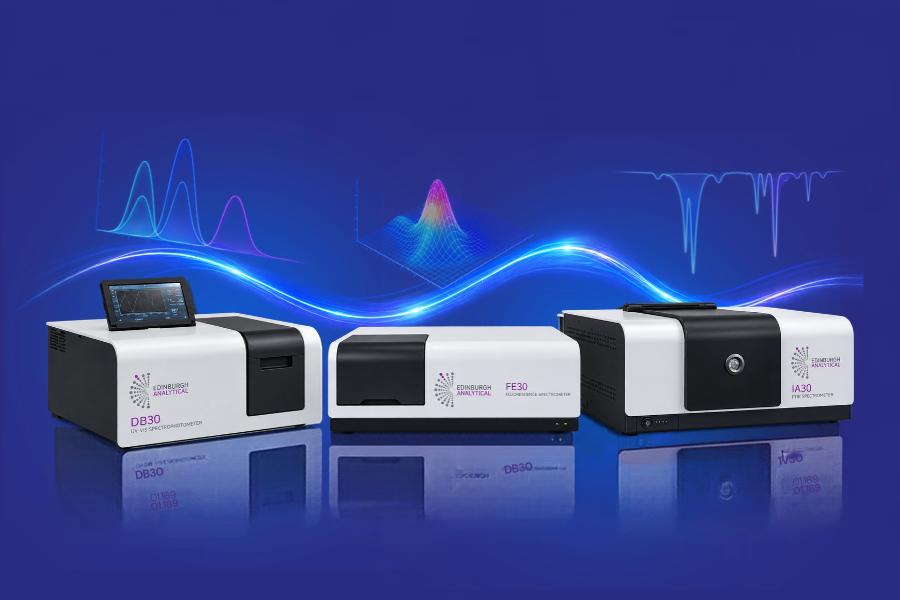
SciSPX offers spectroscopic instruments for laboratories in Belgium, the Netherlands and Luxembourg. Our portfolio includes three complementary technologies for absorption measurements, fluorescence analysis and infrared spectroscopy. Each instrument supports different analytical requirements, from routine concentration determination to advanced molecular characterization.
Instrument | Technique | Spectral range | Primary applications |
|---|---|---|---|
DB30 | Double beam UV-Vis | 190–1100 nm | Absorbance, transmittance, concentration determination |
FE30 | Fluorescence | Excitation and emission: 200–900 nm | Fluorescence analysis, trace detection, molecular studies |
IA30 | FTIR | 8000–350 cm⁻¹ | Chemical identification, functional group analysis, material characterization |
Explore our range of spectroscopic instruments and select the technology that matches your analytical requirements.
Our Xperts can help you compare the available systems and select a configuration suited to your samples and analytical workflow.

Double beam UV-Vis spectrophotometer
DB30
Provides accurate absorbance and transmittance measurements across the UV-Vis spectral range. Its double-beam optical design and flexible sampling options support quantitative analysis, optical characterization and routine laboratory testing.

Fluorescence spectrometer
FE30
Provides sensitive fluorescence measurements for qualitative and quantitative analysis. Its excitation, emission and three-dimensional scanning capabilities support applications in life sciences, environmental analysis, pharmaceuticals and materials research.

FTIR spectrometer
IA30
Enables infrared spectral analysis for chemical identification and material characterization. With flexible sampling accessories, including ATR options, it supports the analysis of solids, liquids, powders and films.
Not sure which spectrometer fits your application?
Our Xperts are happy to discuss your application and help you find the right solution.
