 English
 Dutch
 French

TOC and water analyzers
TOC and water analyzers measure organic contamination and other water-quality parameters in liquid or solid samples. These measurements support water-quality assessment, wastewater monitoring, environmental analysis, cleaning validation and process control.
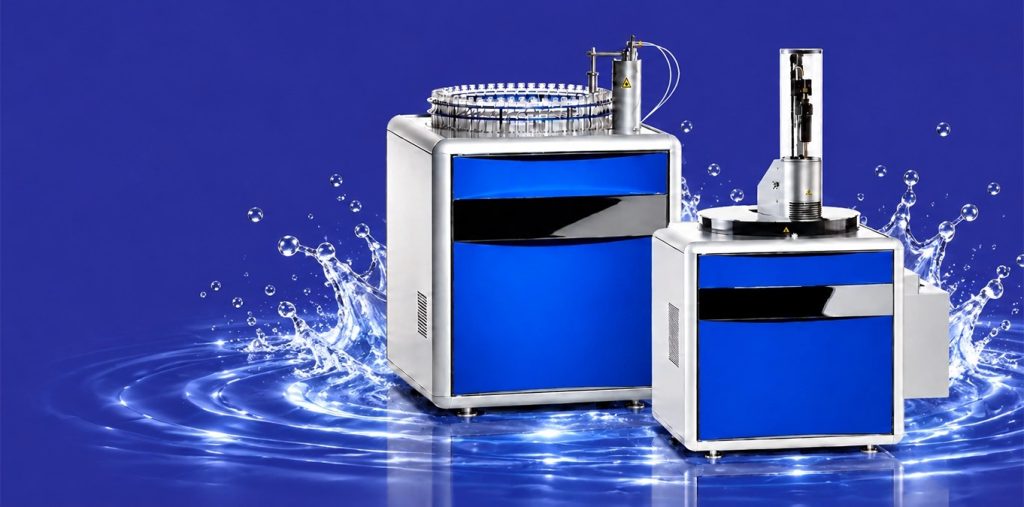
What is total organic carbon?
Total organic carbon, or TOC, represents the amount of carbon associated with organic compounds in a sample. It is widely used as a screening parameter for assessing organic contamination.
TOC does not identify individual organic substances. Instead, it provides a combined measurement of the organic carbon present. This makes it useful for monitoring changes in water quality, verifying cleaning processes and evaluating environmental samples.
TOC can be measured in liquids such as ultrapure water, drinking water, surface water, groundwater, seawater and wastewater. Dedicated instruments can also determine TOC in soil, sediment, sludge, biomass and solid waste.
How does a TOC analyzer work?
A TOC analyzer converts organic carbon into carbon dioxide. The carbon dioxide is subsequently measured, commonly with an infrared detector. Two principal oxidation methods are used within the available range.
High-temperature combustion
During high-temperature combustion, the sample is oxidized inside a heated furnace. This approach can decompose stable organic compounds and is used for both liquid and solid samples.
The vario TOC cube, enviro TOC and soli TOC cube use combustion-based analysis. Their configurations differ according to the sample type and required carbon parameters.
UV/persulfate oxidation
UV/persulfate analyzers use chemical oxidation supported by ultraviolet radiation. The organic carbon is converted into carbon dioxide for subsequent measurement.
This method is used by the acquray and is intended for liquid samples, including applications requiring sensitive TOC determination.
Applications of TOC and water analysis
TOC and water analyzers are used in laboratory testing, environmental monitoring and industrial process control.
Common applications include:
- Ultrapure and pharmaceutical water
- Drinking water
- Groundwater and surface water
- Seawater and brine
- Industrial and municipal wastewater
- Environmental water
- Soil eluates
- Soil, sediment and sludge
- Biomass and biochar
- Solid waste
- Cleaning validation
- Online process and treatment monitoring

TOC, TC and TIC
Several carbon parameters may be relevant depending on the sample and application:
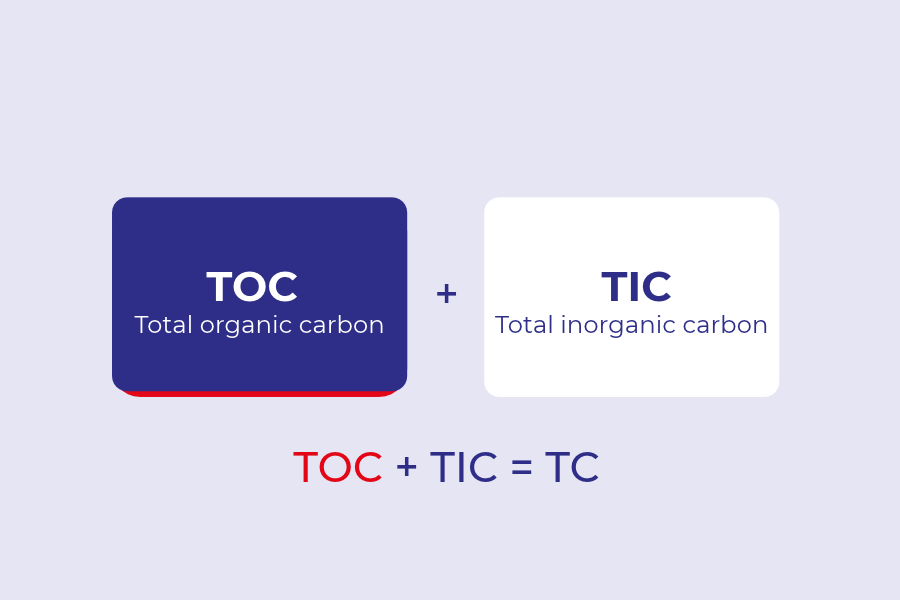
- Total carbon (TC) includes the organic and inorganic carbon in a sample.
- Total inorganic carbon (TIC) represents carbon from inorganic compounds such as carbonates and bicarbonates.
- Total organic carbon (TOC) represents the carbon associated with organic compounds.
TOC can be measured directly or calculated by subtracting TIC from TC. The appropriate approach depends on the sample matrix, expected concentrations and analytical method.
Additional parameters may include dissolved organic carbon, purgeable organic carbon, non-purgeable organic carbon and residual oxidizable carbon. Availability depends on the analyzer and its configuration.
What is chemical oxygen demand?
Chemical oxygen demand, or COD, indicates the amount of oxygen required to chemically oxidize compounds in a water sample under the defined measurement conditions. It is widely used to assess wastewater and monitor treatment processes.
TOC and COD both provide information related to organic contamination, but they measure different properties. TOC measures carbon, while COD represents an oxygen demand. The results are therefore not directly interchangeable without an established relationship for the specific sample stream.
Choosing a TOC or water analyzer
The most suitable system depends on the sample matrix, required parameters, expected concentration range and measurement environment.
Liquid or solid samples
Some analyzers are optimized for liquid samples, while others are designed specifically for solids. A laboratory analyzing both sample types may require a flexible configuration or separate dedicated systems.
Carbon concentration
Ultrapure and pharmaceutical water may require highly sensitive measurement at very low carbon concentrations. Wastewater and environmental samples can contain much higher concentrations, particles or challenging matrix components.
Oxidation method
High-temperature combustion is suitable for diverse matrices and stable organic compounds. UV/persulfate oxidation provides sensitive TOC measurement in liquid samples without using a combustion furnace.
Laboratory or online analysis
Laboratory analyzers process collected samples under controlled conditions. Online analyzers take measurements directly from the sample stream at programmed intervals, providing more continuous insight into process or water-quality changes.
Additional parameters
Depending on the application, laboratories may require TIC, TC, TNb, DOC, POC, NPOC or differentiated carbon measurements. Online systems may also be configured to monitor COD and other water-quality parameters.
Frequently asked questions
What does a TOC analyzer measure?
A TOC analyzer measures the amount of carbon associated with organic compounds in a sample. The result provides an overall indication of organic carbon rather than identifying individual compounds.
What is the difference between TOC and TC?
Total carbon includes both organic and inorganic carbon. Total organic carbon represents only the carbon associated with organic compounds.
Can TOC be measured in solid samples?
Yes. The soli TOC cube is designed specifically for TOC and differentiated carbon analysis in solids such as soil, sediment, sludge, biomass and waste. Other systems may also support solids with an appropriate configuration.
What is the difference between TOC and COD?
TOC measures the carbon present in organic compounds. COD measures the oxygen demand associated with chemical oxidation under the defined test conditions. Because they measure different properties, TOC and COD results are not automatically interchangeable.
What is NPOC?
NPOC stands for non-purgeable organic carbon. Before measurement, purgeable carbon is removed from the acidified sample. The remaining organic carbon is then oxidized and measured.
What is TNb?
TNb represents bound nitrogen measured in a sample. Selected TOC analyzers can determine TNb alongside carbon parameters, depending on their configuration.
Compare our TOC and water analyzers
SciSPX supplies laboratory and online analyzers to laboratories and industries in Belgium, the Netherlands and Luxembourg, for applications ranging from ultrapure water to wastewater, soil and solid waste. The available systems include TOC analyzers based on combustion or UV/persulfate oxidation and an online analyzer for continuous COD monitoring.
The available systems cover liquid and solid samples, different oxidation techniques and both laboratory and online monitoring. Use the comparison below to identify which analyzer best matches your application.
Analyzer | Main sample type | Measurement principle | Main parameters or purpose | Best suited for |
|---|---|---|---|---|
vario TOC cube | Liquid samples, with configurations for solids | High-temperature combustion | TOC, NPOC, TC, TIC, DOC, POC and TNb | Flexible TOC analysis across a broad range of water and sample matrices |
enviro TOC | Environmental water, wastewater and particle-containing samples | High-temperature combustion | TOC and TNb | Environmental and wastewater laboratories |
soli TOC cube | Solid samples | High-temperature combustion | TOC, TIC, ROC and temperature-dependent carbon differentiation; optional TN | Soil, sediment, sludge, biomass, biochar and solid waste |
acquray | Liquid samples | UV/persulfate oxidation | Sensitive TOC and NPOC analysis | Pure water, drinking water, pharmaceutical water and routine liquid analysis |
Online PeCOD Analyzer | Online water and wastewater streams | Online COD analysis | Automated COD monitoring | Continuous process, wastewater and treatment monitoring |
Find the right TOC and water analyzer
Selecting a suitable analyzer begins with the sample type and required parameter. Clean liquid samples, environmental water, wastewater and solid materials each present different analytical requirements.
We can help you compare our systems and select a configuration suited to your analytical requirements.

POC, TC, TIC, TNb, TOC
vario TOC cube
A configurable TOC and TNb analyzer for parameters including TOC, NPOC, TC, TIC, DOC, POC and TNb. It uses high-temperature combustion and supports applications ranging from ultrapure water to industrial wastewater, concentrated salt solutions and solid samples.

POC, TC, TIC, TNb, TOC
enviro TOC
Designed for high-throughput TOC and TNb analysis in environmental water and wastewater. Combustion at up to 1,200 °C enables the analysis of liquid, particle-containing and solid samples.

ROC, TC, TIC900, TN, TOC400
soli TOC cube
Determines TOC, TIC and residual oxidizable carbon in solid samples such as soil, sediment, sludge, biomass, biochar and waste. It supports direct, subtraction-based and temperature-programmed TOC determination, with optional total nitrogen analysis.

ROC, TC, TIC, TIC900, TOC, TOC400
acquray
Uses UV/persulfate oxidation for sensitive TOC analysis in liquid samples. It is suitable for pure water, drinking water, pharmaceutical water and groundwater, with automated sample handling and NPOC acidification available.

COD
Online PeCOD analyzer
Provides automated COD monitoring directly from water and wastewater streams. It supports continuous monitoring in municipal treatment, industrial wastewater management and food and beverage operations.
Wastewater analysis with the new ISO 20236
Starting January 1, 2026, laboratories in the Benelux region will face a major shift in wastewater analysis with the introduction of ISO 20236. This new regulation, ISO 20236, mandates that all wastewater be analyzed using a TOC/TNb analyzer. It replaces the current method of measuring wastewater through Chemical Oxygen Demand (COD).
Not sure which analyzer fits your application?
Our Xperts are happy to discuss your application and help you find the right solution.
