English
 Dutch
 French


Online Process Analyzer for COD/BOD Analysis
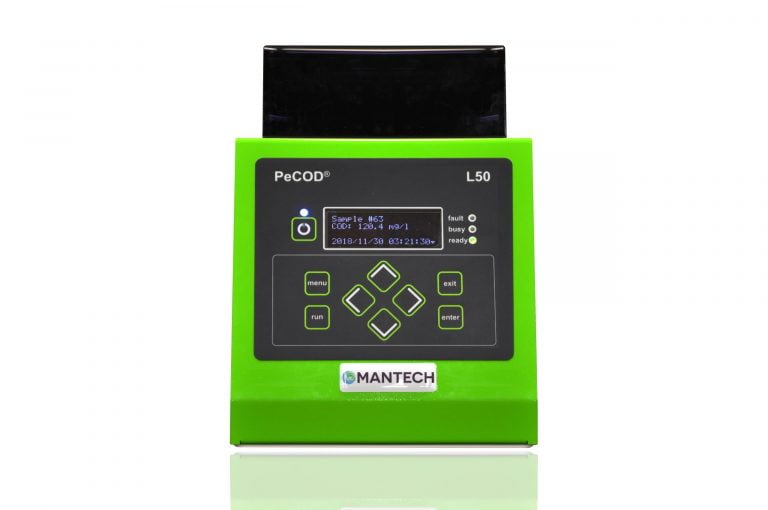
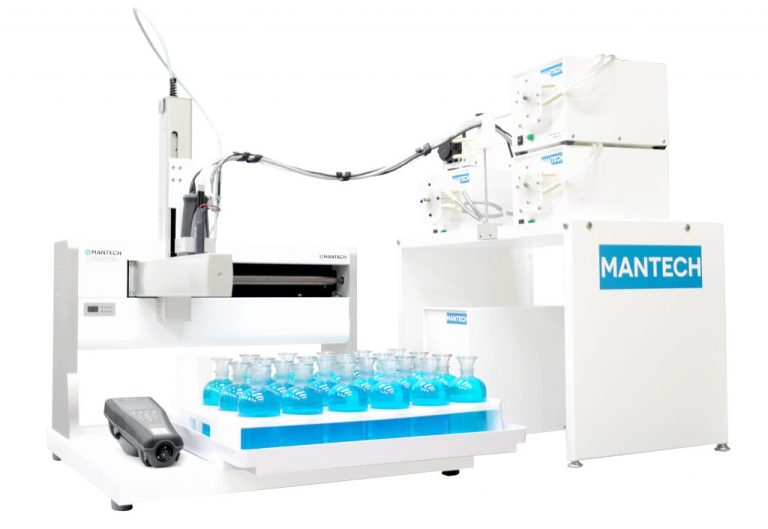
The Online L50 PeCOD Analyzer is an autonomous online analyzer for real-time measurement of oxygen demand in water samples. The system uses MANTECH’s patented PeCOD® nanotechnology-based photoelectrochemical method and is intended for hands-free sampling and analysis.
The analyzer provides rapid empirical results that correlate strongly with traditional COD and BOD measurements.
How does the PeCOD® technology work?
The analyzer uses a nanotechnology-based analytical method rather than optical or surrogate measurement techniques.
At the core of the system is the PeCOD® sensor, which includes:
- A UV-activated TiO₂ (titanium dioxide) nanoparticle photocatalyst
- An external electrical circuit
The oxidation potential generated by the UV-activated sensor enables:
- Rapid analysis
- Oxidation of virtually all species
- Measurement of COD and BOD
The oxidation efficiency parameters is adjustable for both COD and BOD analysis using the same sample.
What are the advantages of the Online PeCOD Analyzer?
Rapid and empirical results
The system delivers results that show strong correlation to traditional:
- COD methods
- BOD methods
Minimal operator interaction
The analyzer is suitable for autonomous operation and reduced system interaction:
- Hands-free sampling and analysis
- Automated calibration and quality control
- Emailed alerts for reagent and consumable replacement
- Emailed analytical results
Flexible run setup
Users can schedule sampling at selected intervals, including hourly operation or custom-defined frequencies.
Why is the PeCOD method considered safer?
The PeCOD method combines advanced oxidation with green electrochemistry.
Key characteristics include:
- No mercury required
- No dichromate required
- No hazardous waste produced
The system is designed to reduce environmental impact while improving safety for operators and laboratories.
Which parameters and communication options are supported?
The Online L50 PeCOD Analyzer supports:
- Modbus TCP communication protocol
- CSV report export
Additional parameters can also be integrated, including:
- pH
- Alkalinity
- Conductivity
- Ammonia
Compatible matrices
The analyzer is compatible with a range of water matrices:
- Drinking water
- Wastewater
- Ground water
- Sea water
- Surface water
- Electroplating baths
Used by a variety of industries
The system is used in multiple industrial and laboratory environments, including:
- Industrial wastewater treatment plants
- Municipal wastewater treatment plants
- Drinking water treatment plants
- Pulp and paper mills
- University and college laboratories
- Food and beverage production facilities
Specifications
| COD method | Photocatalytic TiO₂ oxidation |
|---|---|
| Measuring range | 0.7–15,000 mg/L |
| Auto‑dilution capability | Extends range to > 200,000 mg/L |
| Particle size handling | < 50 µm standard Automated homogenizer built‑in for particles > 50 µm |
| pH range | 4–10 (after electrolyte addition) |
| User control | Fully automated via software and touchscreen HMI |
| Calibration and QC | Automatic, at timed intervals |
| Precision | ≤ ± 10 % |
| Compatible matrices | Water Wastewater Process streams Natural waters |
| Sampling method | Tank or split‑stream reservoir (not provided by MANTECH) |
| Rinsing procedures | Potable or deionized water required |
| Waste disposal | Non‑hazardous waste; floor drain or carboy |
| Installation options | Wall‑mounted or A‑frame |
| System dimensions (cabinet) | 30″ × 36″ × 16″ (76 × 91 × 41 cm) |
| Enclosure material | Corrosion‑resistant steel |
| Operating temperature | 5–50 °C |
| Power requirements | 110–240 V, 50/60 Hz |
| Parameter add‑ons | pH, conductivity, alkalinity, fluoride, hardness, and more |
| Data output | MODBUS connection for data transfer |