English
 Dutch
 French

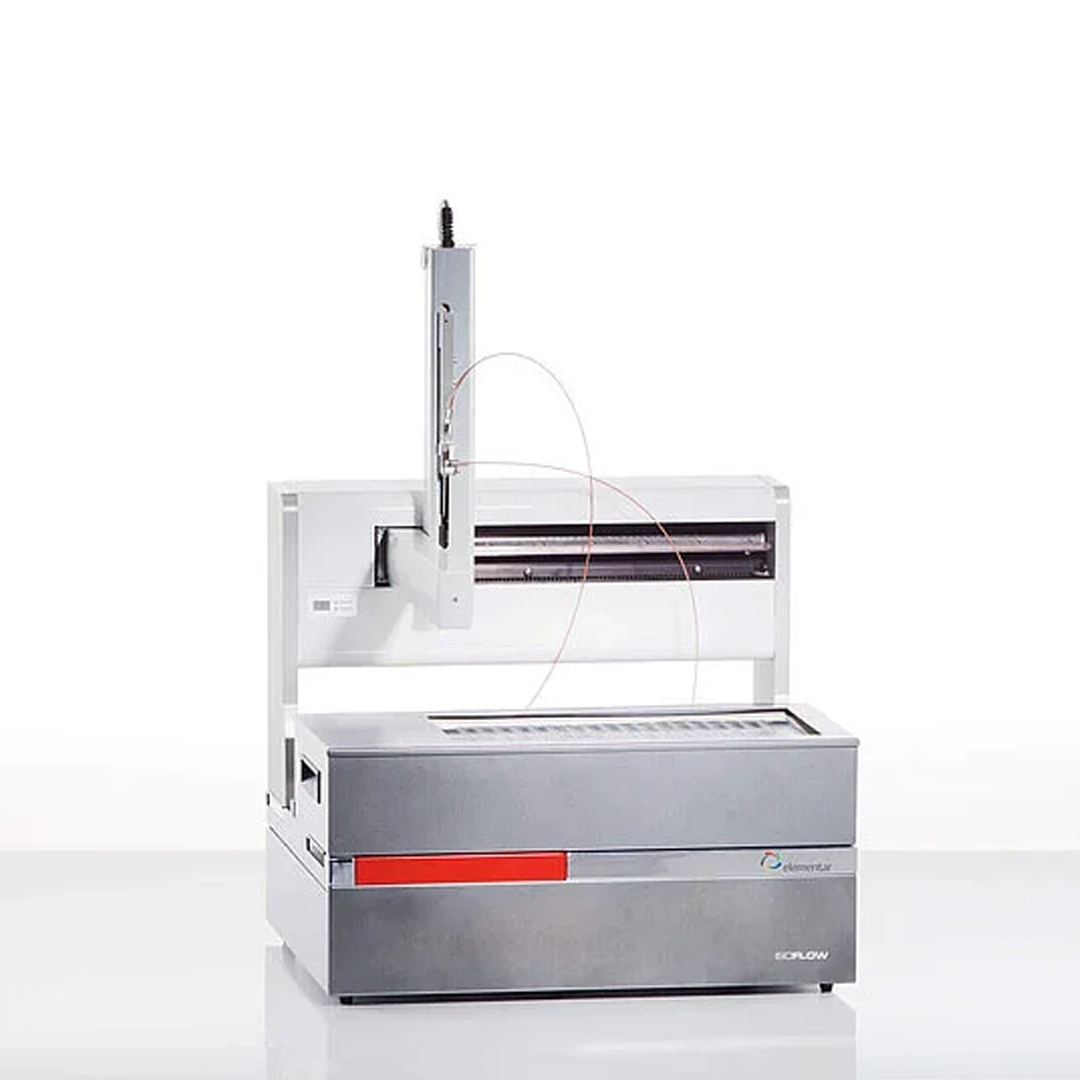
Isotope analysis of gases, liquids, and carbonate minerals
What is iso FLOW?
Iso FLOW is a fully automated, continuous flow preparation system for isotope ratio mass spectrometry (IRMS). It is ideal for the isotopic analysis of samples prepared in septum-sealed vials, including gases, liquids, and carbonate materials.
The system supports a wide range of applications such as geoscience, climate research, food authenticity, hydrology, and clinical studies. Its flexibility and automation make it a versatile solution for IRMS laboratories working with diverse sample types.
Why use iso FLOW for isotope analysis?
Iso FLOW offers specific advantages for liquid and carbonate isotope analysis in comparison to other preparation techniques.
For water isotope analysis (δ²H and δ¹⁸O), it uses an equilibration technique that avoids interference from dissolved or particulate organic matter. This eliminates the need for sample pre-treatment such as filtration or distillation, even for complex matrices like:
- Fruit juices
- Wines
- Urine
- River and estuarine waters
For carbonate analysis, iso FLOW enables accurate measurement of impure carbonate samples (e.g. apatite carbonates). Unlike dual inlet methods, it removes interferences caused by hydroxyapatite using its integrated UltiTrap GC separation system.
Flexibility
The system is ideal to handle multiple sample types and analytical methods within a single platform.
Key flexibility features:
- Analysis of gases, liquids, and carbonates in one system
- Configurable operation for single or multiple analysis modes
- Compatibility with different sample vial formats
- Operator-defined sampling methods (single or multiple loop fills)
This allows laboratories to tailor the system to their specific analytical workflows.
How does UltiTrap improve analytical performance?
At the core of iso FLOW is the UltiTrap GC separation device, based on Advanced Purge and Trap (APT) technology.
UltiTrap can operate in different modes:
- Isothermal mode: up to 200 °C for fast analysis of simple samples
- Dynamic mode: sub-ambient temperatures using thermoelectric cooling and rapid heating
This enables:
- Improved focusing and separation of gases
- Better limits of quantification for small samples
- Operation without cryogenics
Automation
Iso FLOW provides full control of analytical parameters through the lyticOS® Software Suite.
This includes:
- Control of flow rates and valves
- Digital mass flow controllers for stable gas handling
- Method-based variation of gas flows
- Automated sleep and wake-up modes to conserve resources
The system enables fully automated sample preparation and analysis, reducing manual intervention and improving reproducibility.
High sample throughput
Iso FLOW is ideal for high-throughput laboratories with large sample volumes.
Capacity per sequence:
- Up to 180 heated samples (liquids or carbonates)
- Up to 220 non-heated samples (gases)
Additional features supporting throughput:
- Automated sample preparation and gas aliquoting
- Integrated data processing via lyticOS®
- Temperature-controlled sample tray up to 90 °C (±0.1 °C)
Unique needle design
The system uses a multi-core, micro-volume needle for automated sample handling.
This single needle is used to:
- Flush sample vials
- Deliver reagents
- Extract prepared sample gas
This design:
- Simplifies instrument setup
- Reduces maintenance
- Increases flexibility across different analysis types
How are gas samples analyzed?
Gas samples require no pre-treatment and can be analyzed directly.
Key characteristics:
- Analysis time of less than 4 minutes per sample
- Standard use of 12 ml vials (other formats possible)
- Configurable sampling (single or multiple loop fills)
Typical applications include:
- Breath analysis (δ¹³C)
- Atmospheric gases
- Pure gas samples
How does liquid isotope analysis work?
For water isotope analysis, iso FLOW uses an equilibration technique.
Process:
- Sample vial headspace is flushed with equilibration gas
- Isotopic exchange occurs between liquid and gas phase
- Equilibration time:
- ~4 hours for δ¹⁸O
- ~90 minutes for δ²H (with platinum catalyst)
- The equilibrated gas is then analyzed by IRMS
The system uses a single equilibration gas, reducing gas consumption and simplifying operation.
How are carbonate samples analyzed?
Carbonate analysis is based on acid digestion.
Process:
- Phosphoric acid is injected into the sample vial
- CO₂ is generated through reaction with carbonate
- Gas is transferred to IRMS for isotope analysis
Key advantages:
- Direct-drive acid pump for precise and rapid dosing
- Analysis of up to 180 samples per sequence
- Suitable for samples down to 100 µg
Analytical configurations
You can configure Iso FLOW for different analysis modes:
| Analysis mode | Sample type | Capacity per sequence | Key conditions |
|---|---|---|---|
| Gas mode | Gases | Up to 220 samples | < 4 min per sample |
| Liquid mode | Waters, liquids | Up to 180 samples | Heated tray (~40 °C) |
| Carbonate mode | Carbonate minerals | Up to 180 samples | Temperature range 30–90 °C |
This allows flexible configuration depending on laboratory needs.
Sample types
Iso FLOW supports a broad range of sample matrices:
- Breath samples
- Atmospheric and pure gases
- Groundwater and precipitation
- Seawater, river water, estuarine water
- Ice cores
- Fruit juices and purées
- Wines, vinegars, and spirits
- Biological fluids
- Pure and biogenic carbonates
- Soil and apatite carbonates
- Dissolved inorganic carbonates (DIC)