English
 Dutch
 French

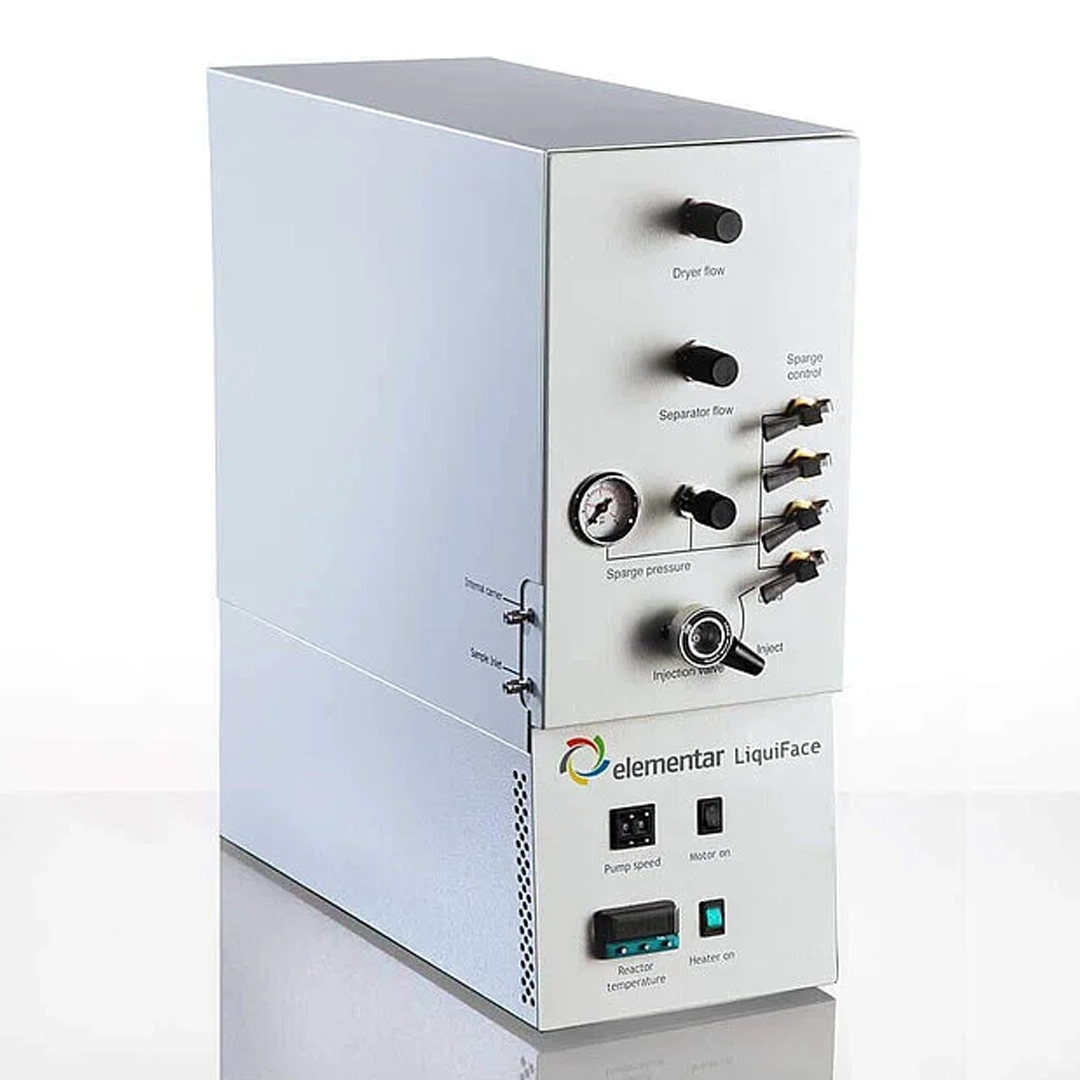
LC-IRMS interface
What is LiquiFace?
LiquiFace is an LC-IRMS interface ideal for compound-specific isotope analysis of dissolved organic compounds in aqueous samples. It enables high-performance carbon isotope analysis (δ¹³C) of compounds separated by liquid chromatography (LC).
The system particularly suits research applications where compounds are thermolabile or require derivatization, making gas chromatography less suitable. Typical target compounds include carbohydrates, amino acids, alcohols, organic acids, and peptides, which are widely studied in food science and biogeochemistry.
LiquiFace converts LC-separated compounds into CO₂ through wet-chemical oxidation, followed by extraction into the gas phase and analysis by isotope ratio mass spectrometry.
Why is LC-IRMS used for compound-specific analysis?
Liquid chromatography isotope ratio mass spectrometry (LC-IRMS) is especially useful for polar or thermally sensitive compounds that GC-based methods cannot easily analyze.
It allows direct isotope analysis of:
- Carbohydrates
- Amino acids
- Organic acids
- Alcohols
- Peptides
This makes it highly relevant for environmental, biological, and food-related research applications.
How does LiquiFace perform δ¹³C analysis?
LiquiFace performs online conversion of dissolved organic carbon into CO₂ using wet-chemical oxidation. The system then extracts CO₂ from the aqueous phase and transfers it into the IRMS system for δ¹³C analysis.
The system is designed to ensure:
- High isotopic precision and accuracy
- Excellent linearity across concentration ranges
- Fractionation-free oxidation under controlled conditions
A low-temperature microreactor ensures complete conversion of organic carbon without compromising chromatographic integrity.
For bulk isotope analysis (e.g. TOC), you can also configure the system with a direct injection valve and a 25 µl sample loop.
High analytical performance
LiquiFace uses optimized reagent mixing in combination with a high-efficiency membrane gas exchanger to ensure precise and stable analysis.
Performance is supported by:
- Continuous wet-chemical oxidation
- Low-band spreading in the microreactor
- Fractionation-free conversion process
- Stable signal transfer into the IRMS
This results in consistent δ¹³C measurements independent of sample concentration or matrix.
How does LiquiFace improve system uptime?
Combining LiquiFace with compatible IRMS systems delivers high operational robustness and reduces downtime.
Key design advantages include:
- Oxygen-tolerant system architecture
- Long-life ionization components in compatible IRMS systems
- Stainless steel analyzer housing for improved vacuum stability
- No requirement for additional reduction furnace in oxygen handling
These features reduce maintenance needs and improve long-term system stability.
How does the system handle oxygen excess?
LC-IRMS systems often introduce excess oxygen due to wet-chemical oxidation processes. LiquiFace is ideal to handle this efficiently.
When coupled with compatible IRMS systems, it offers:
- High tolerance to excess oxygen load
- Reduced risk of ion source filament damage
- Elimination of the need for an online reduction furnace
- Reduced peak broadening and lower consumable usage
This improves both instrument longevity and analytical quality.
Low operating costs
Unlike systems relying on high-pressure LC pumps for reagent delivery, LiquiFace uses peristaltic pumps.
This provides:
- Lower maintenance requirements
- Reduced operational complexity
- Lower consumable costs
- Stable and precise reagent flow
The system supports up to four reagent channels for flexible method development.
Flexible LC setup
You can couple LiquiFace to virtually any high-performance liquid chromatography (HPLC) or ion chromatography (IC) system.
It supports:
- HPLC coupling for continuous sample flow
- Direct injection using an internal pump system
- Flexible LC system selection for method development
Connections are made using finger-tight PEEK™ unions, ensuring compatibility and ease of use.
How does it preserve chromatographic integrity?
The system is designed to minimize impact on chromatographic separation after LC analysis.
Once compounds are separated by the LC column, the interface ensures:
- Minimal peak distortion
- Preservation of chromatographic resolution
- Reliable transfer of separated compounds to the IRMS
This is particularly important for complex sample mixtures requiring high-resolution separation.
How does low-temperature conversion work?
Conversion of LC effluent into sample gas takes place in a low-temperature reactor (up to 100 °C). This allows analysis of thermolabile compounds that would degrade at higher temperatures.
Process overview:
- LC effluent is mixed with reagents in the reactor
- CO₂ is generated under controlled low-temperature conditions
- Gas mixture is cooled to room temperature
- Gas exchanger separates CO₂ from the liquid phase
- CO₂ is transferred to the IRMS via a water removal membrane
A dual-stage drying system ensures efficient water removal and stable signal quality.
Sample types
LiquiFace supports a wide range of aqueous sample types, including:
- Carbohydrates
- Amino acids
- Alcohols and organic acids
- Peptides
- Biological materials
- River and groundwater samples
- Soil water extracts
It is suitable for both dilute freshwater systems and more complex environmental matrices.
Compounds and applications
| Analytical technique | LC‑IRMS for compound‑specific δ¹³C analysis |
| Suitable compounds | Carbohydrates, amino acids, organic acids, alcohols, peptides |
| Sample matrix | Dissolved organic compounds in aqueous samples |
| Research fields | Environmental science, biogeochemistry, food science, biological research |
| GC alternative | Suitable for polar and thermolabile compounds not amenable to GC‑IRMS |