 English
 Dutch
 French

Refractometers
Refractometers are analytical instruments used to measure the refractive index of liquids and other suitable samples. They support concentration determination, product identification, and quality control across various industries.
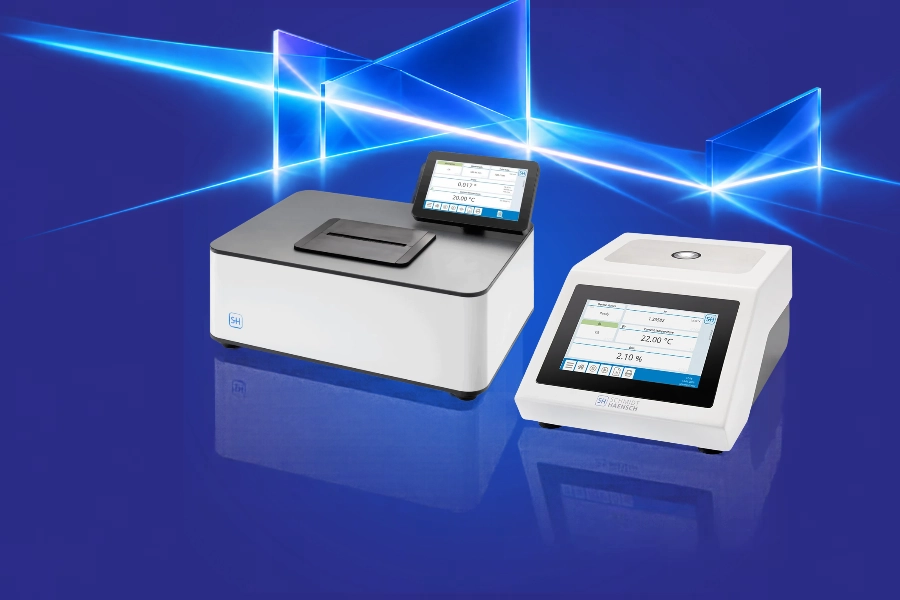
What are refractometers?
Refractometers are analytical instruments used to measure the refractive index of liquids and other suitable samples. They support concentration determination, product identification, and quality control across various industries.
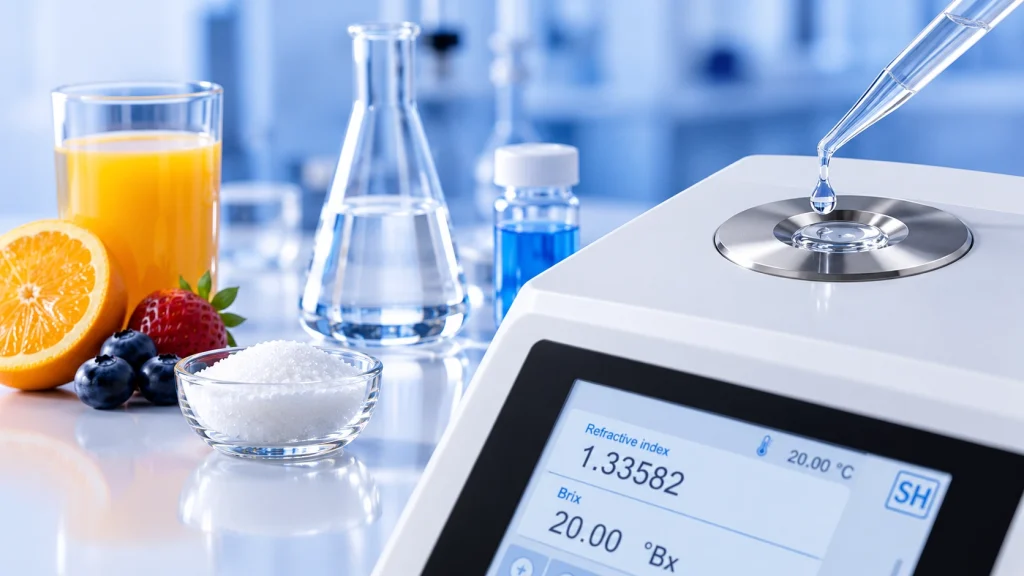
In food and beverage laboratories, refractometers commonly measure sugar concentration expressed in degrees Brix (°Bx). They also support pharmaceutical analysis, chemical manufacturing, and other applications where refractive index provides valuable information about sample composition.
Polarimetry versus refractometry
Polarimetry and refractometry are both optical analytical techniques. However, they measure different physical properties.
Polarimetry measures the rotation of polarized light caused by optically active substances. Refractometry measures the refractive index of a sample.
Parameter | Polarimetry | Refractometry |
Measurement principle | Optical rotation | Refractive index |
Primary result | Rotation angle (°) | Refractive index (nD) |
Typical applications | Chiral compounds, sugar analysis, pharmaceuticals | Concentration analysis, Brix, liquid characterization |
Sample requirements | Optically active substances | Optically transparent or suitably measurable samples |
Main advantage | Information about optical activity | Rapid characterization of liquid composition |
In the sugar industry, laboratories often combine both techniques. Polarimetry measures the optical rotation associated with sucrose. Refractometry provides a Brix value representing soluble solids under the applicable measurement scale. Together, these measurements can support calculations of sugar purity. However, the interpretation depends on the sample composition and analytical method.
What is refractive index measurement?
Refractive index measurement determines how light changes direction when passing between materials with different optical properties. The refractive index depends on the sample’s composition, temperature, and measurement wavelength. These characteristics make refractometry useful for identifying substances and monitoring concentration changes.
In laboratory analysis, refractive index measurement supports:
Concentration determination: estimating the concentration of dissolved substances using suitable calibration relationships.
Quality control: monitoring product consistency between production batches.
Product identification: comparing measured values with established reference data.
Sugar analysis: determining Brix values in juices, syrups, and sugar solutions.
Process monitoring: detecting changes in sample composition during manufacturing.
Refractometry provides rapid measurements and generally requires only small sample volumes. However, the interpretation of results depends on the sample matrix and measurement conditions.
How does a refractometer work?
A refractometer measures the optical behavior of light at the interface between a sample and a measuring prism. Most digital laboratory refractometers use the principle of critical angle measurement, which relates the angle of light at the prism-sample interface to the sample’s refractive index.
Critical angle measurement
When light reaches the interface between two materials, its behavior depends on their refractive indices and the angle of incidence. Digital refractometers detect the boundary between illuminated and dark regions created by total internal reflection. The instrument uses this boundary to calculate the sample’s refractive index.
This approach allows precise measurements without visually identifying the boundary through an eyepiece.
Temperature control and compensation
Temperature influences refractive index. Therefore, consistent temperature conditions are essential for reliable measurements. Laboratory refractometers may use integrated temperature control to maintain defined measurement conditions. Other instruments apply temperature compensation when supported by the sample type and calibration. Temperature compensation is not universally interchangeable with measuring a sample at a controlled reference temperature.
Refractive index and Brix measurement
Refractive index is commonly expressed as nD, referring to the sodium D spectral line near 589 nm. Brix (°Bx) represents the mass percentage of sucrose in an aqueous sucrose solution. For example, a pure sucrose solution containing 10 g of sucrose per 100 g of solution has a value of 10 °Bx. Refractometers calculate Brix values from refractive index using established sucrose relationships.
For products containing other dissolved substances, such as fruit juices, the displayed Brix value represents an apparent sucrose-equivalent concentration rather than a direct measurement of individual sugars.
Digital versus handheld refractometers
Digital laboratory and handheld refractometers use related optical principles but serve different analytical workflows.
Feature | Digital laboratory refractometers | Handheld refractometers |
|---|---|---|
Main application | Laboratory analysis and quality control | Rapid field and routine measurements |
Measurement | Automated electronic detection | Model-dependent optical or digital reading |
Temperature management | Often includes controlled measurement temperature | Typically more dependent on ambient and sample conditions |
Data handling | Model-dependent digital functions | Generally simpler workflows |
Portability | Primarily laboratory-based | Designed for portable use |
Best suited for | Repeatable laboratory measurements | Convenient on-site testing |
Laboratories requiring tightly controlled measurement conditions generally benefit from a laboratory refractometer. Handheld models are useful when portability and rapid sample checks take priority.
Applications of refractometers
Refractometers are widely used wherever refractive index or concentration measurements support product development, process control, or quality assurance.
Common applications include:
Food and beverage analysis: brix measurement in fruit juices, soft drinks, syrups, concentrates, and other liquid products
Sugar production
Pharmaceutical quality control
Chemical manufacturing
Cosmetics and fragrances
Petrochemical analysis
Research and development concentration-dependent behavior of liquid formulations
The appropriate instrument depends on the sample properties, required measurement range, wavelength, and temperature conditions.

Choosing a refractometer
Sample type and measurement range
Different liquids have different refractive indices. Select an instrument that covers the expected measurement range and supports the intended sample type.
Measurement accuracy and repeatability
Routine concentration checks and demanding laboratory applications may require different performance levels. Evaluate the manufacturer’s stated accuracy, repeatability, and calibration conditions.
Temperature control
Temperature is a critical measurement variable. Integrated temperature control is particularly valuable when comparing results across samples, operators, or laboratories.
Measurement wavelength and dispersion
Most routine refractive index measurements use a defined wavelength. Applications involving optical dispersion may require instruments capable of measuring at multiple wavelengths.
Sample handling and cleaning
Consider sample viscosity, available volume, cleaning requirements, and measurement frequency. These factors influence both instrument selection and daily laboratory efficiency.
Laboratory or portable measurements
A handheld refractometer may be sufficient for rapid checks. A laboratory system is generally more appropriate when measurement traceability, controlled conditions, or advanced analytical functions are important.
Frequently asked questions
What does a refractometer measure?
A refractometer measures the refractive index of a sample. This optical property describes how light propagates through a material. With suitable calibration, the measured value can also indicate the concentration of dissolved substances.
What is the difference between refractive index and Brix?
Refractive index is an optical property of a material. Brix is a concentration scale based on aqueous sucrose solutions. Refractometers can convert refractive index into Brix using standardized relationships, but other dissolved substances may influence the result.
Can a refractometer measure sugar content in fruit juice?
Yes. Refractometers commonly measure Brix in fruit juices and other beverages. However, acids and other dissolved compounds also affect refractive index. Therefore, the result represents apparent Brix rather than the exact concentration of individual sugars.
Why is temperature important in refractometry?
Refractive index changes with temperature. Measuring at a controlled temperature improves comparability and repeatability. Temperature compensation can also help, provided the correction is appropriate for the sample and measurement scale.
How do I choose the right refractometer for my laboratory?
Start with the sample type, required measurement range, accuracy, and temperature conditions. Also consider whether you need Brix measurement, advanced optical dispersion analysis, or portable operation.
Compare our refractometers
SciSPX supplies refractometers for laboratory analysis, routine quality control, and specialized optical measurements throughout the Benelux. Our range includes compact digital instruments, advanced laboratory refractometers, and a portable handheld model.
Instrument | Main characteristics | Best suited for |
|---|---|---|
VariRef² | Full-range digital refractometer | Versatile laboratory analysis |
ATR P | High-performance laboratory refractometer | Demanding quality control applications |
ATR V/VT | Benchtop refractometers with touchscreen operation | Routine laboratory measurements |
ATR BR | Compact digital refractometer | Routine concentration and refractive index checks |
DHR | Digital handheld refractometer | Portable and on-site measurements |
Find the right refractometer
Whether you need routine Brix measurements or advanced optical characterization, we can help you select a suitable instrument.

Versatile analysis
VariRef²
Full-range digital refractometer for versatile laboratory applications. It supports refractive index and concentration measurements across different sample types, making it suitable for quality control and analytical laboratories.

High-precision analysis
ATR P
High-performance laboratory refractometer designed for demanding analytical applications. It supports precise refractive index measurements where reliable results and controlled measurement conditions are essential.

Routine quality control
ATR V/VT
Combines digital refractive index measurement with intuitive touchscreen operation. These benchtop refractometers are suitable for routine quality control and concentration measurements in laboratory environments.

Compact & reliable
ATR BR
Compact digital refractometer for routine laboratory measurements. Its space-saving design makes it suitable for laboratories that need straightforward refractive index and concentration analysis.

On-site analysis
Handheld refractometer DHR
Digital handheld refractometer designed for portable refractive index and concentration measurements. It offers a practical solution for rapid sample checks outside a conventional laboratory setting.
Not sure which refractometer fits your application?
Our Xperts are happy to discuss your application and help you find the right solution.
