 English
 Dutch
 French

Fat analyzers
Fat analyzers determine the fat content of food, feed and other products. Rapid fat analysis supports quality control, nutritional testing, formulation and process monitoring without the lengthy workflow associated with traditional solvent-extraction methods.
What is fat analysis?
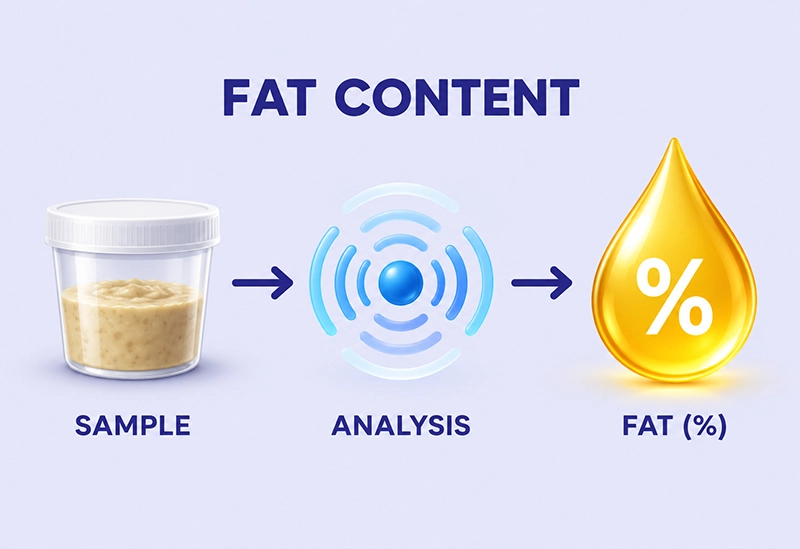
Fat analysis determines the amount of fat present in a sample. The result is generally reported as a percentage of the sample mass and may be expressed on an as-is or dry-matter basis, depending on the analytical method and reporting requirements.
Fat content is an important compositional parameter because it can influence:
- Nutritional values
- Product quality and consistency
- Texture and sensory properties
- Raw-material acceptance
- Production yields
- Formulation costs
- Compliance with product specifications
The appropriate analytical technique depends on the sample, required result, measurement speed and applicable standard.
How does a rapid fat analyzer work?
Rapid fat analyzers can use different measurement principles. The CEM systems use TD-NMR or a combination of rapid moisture measurement and data modelling.
TD-NMR fat analysis
Time-domain nuclear magnetic resonance, or TD-NMR, measures the response of hydrogen nuclei when a sample is exposed to a magnetic field and radiofrequency pulses.
The ORACLE uses a specialized pulse sequence to isolate the response from hydrogen associated with fat molecules. This allows the system to determine total fat without using solvents or matrix-specific calibrations.
The analysis itself takes approximately 30 seconds. When moisture or solids results are also required, ORACLE can be combined with the SMART 6 moisture analyzer.
Rapid fat analysis in raw meat
Raw-meat analysis requires a different approach because laboratories and production facilities often need several compositional results from the same sample.
ProFat uses dual-frequency drying to determine moisture. Microwave energy heats the sample internally, while infrared energy heats its surface. The measured moisture result is combined with data modelling to estimate fat and protein content.
This provides moisture, fat and protein results for raw and pre-blended meat in approximately 2.5 minutes.
TD-NMR versus solvent-extraction fat analysis
Traditional reference methods generally extract fat from a prepared sample using an organic solvent. The extracted material is then measured gravimetrically.
These methods can provide established reference results but may require several preparation, extraction, evaporation and weighing steps. The required solvent and procedure depend on the sample and analytical method.
TD-NMR measures the response of fat molecules without extracting the fat from the sample. The ORACLE therefore avoids solvents and provides a result in approximately 30 seconds.
The selected method should correspond with the sample, reporting requirements and applicable analytical standard. Laboratories replacing or supplementing an existing reference method should verify the required procedure for their application.
Applications of fat analysis
Rapid fat analysis is used in food-production facilities, quality-control laboratories and contract-testing laboratories.
Common applications include:
- Dairy products
- Meat and poultry
- Raw and pre-blended meat
- Alternative meat products
- Alternative dairy products
- Processed foods
- Snack foods
- Animal feed
- Nutritional products
- Ingredient and raw-material testing
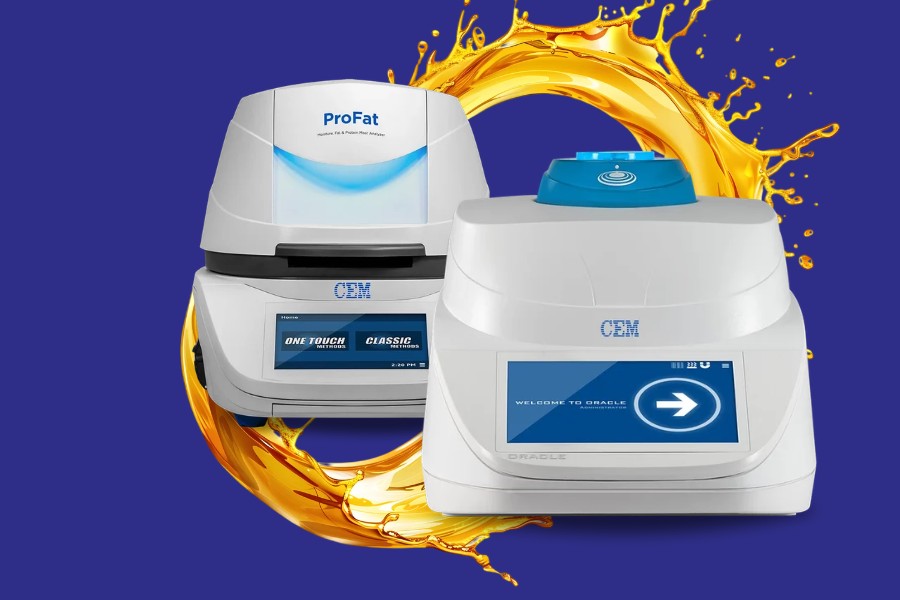
ORACLE is intended for total-fat determination across a broad range of sample matrices. ProFat is specifically designed for rapid compositional analysis of raw meat and meat blends.

Choosing a fat analyzer
Several analytical and practical factors should be considered when selecting a system.
Sample type
The first consideration is whether the laboratory analyzes varied food and feed matrices or specifically raw meat. ORACLE is intended for broad total-fat analysis, while ProFat focuses on raw and pre-blended meat.
Required parameters
ORACLE measures total fat. When paired with a compatible moisture analyzer, the workflow can provide moisture or solids and fat results.
ProFat provides moisture, fat and protein estimates from one rapid raw-meat analysis.
Measurement principle
TD-NMR provides direct fat measurement by detecting the response from fat molecules. ProFat directly measures moisture and uses a mathematical model to estimate fat and protein.
The appropriate approach depends on whether the laboratory requires direct total-fat measurement or rapid multi-parameter process-control data.
Analysis time
ORACLE provides the fat result in approximately 30 seconds. ProFat provides moisture, fat and protein results in approximately 2.5 minutes.
The complete workflow may also include sample preparation, drying or conditioning, depending on the system and sample.
Calibration and method requirements
ORACLE does not require matrix-specific calibration or method development for fat measurement.
ProFat uses a curve-fitting model for fat and protein estimation. It is intended for defined raw-meat applications and should be configured for the products being analyzed.
Laboratory or at-line operation
ORACLE is suitable for laboratories requiring standardized total-fat measurements across different products. ProFat is a compact at-line solution intended to support rapid decisions during raw-meat production and blending.
Frequently asked questions
What does a fat analyzer measure?
A fat analyzer determines the fat content of a sample. Depending on the system, it may measure total fat directly or estimate fat alongside other compositional parameters such as moisture and protein.
What is TD-NMR fat analysis?
TD-NMR uses a magnetic field and radiofrequency pulses to measure signals from hydrogen nuclei. The ORACLE isolates the signal associated with fat molecules to determine total fat without solvent extraction.
Which methods are used to determine fat content?
Fat can be determined using solvent extraction, hydrolysis followed by extraction, nuclear magnetic resonance, infrared spectroscopy and other instrumental techniques. The appropriate method depends on the sample matrix, required analysis time and applicable analytical standard.
What is the difference between total fat and crude fat?
Total fat is intended to represent all fat present in a sample. Crude fat is an operational result determined through a specified solvent-extraction procedure and may not include all bound or less readily extractable lipids. The terms should therefore not be used interchangeably without considering the analytical method.
Does moisture content affect a fat result?
Moisture influences the proportion of fat reported on an as-is basis. Some analytical methods also require the sample to be dried before fat determination. Accurate moisture data may therefore be needed to compare results or convert between as-is and dry-matter values.
How should a sample be prepared for fat analysis?
The sample should be representative of the material being tested and sufficiently homogeneous. Grinding, mixing, drying or hydrolysis may be required depending on the sample and analytical method. The prescribed preparation procedure should be followed to avoid biased results.
What is the difference between ORACLE and ProFat?
ORACLE is a direct total-fat analyzer intended for varied food and feed samples. ProFat is a multi-parameter system specifically designed for rapid analysis of raw meat and meat blends.
Our fat analyzers
SciSPX supplies fat analyzers to laboratories and food-production facilities in Belgium, the Netherlands and Luxembourg. The available systems include a TD-NMR analyzer for direct total-fat measurement across varied sample matrices and an at-line analyzer for moisture, fat and protein in raw meat.
The systems differ in their measurement principle, sample scope, reported parameters and intended workflow. Use the comparison below to identify which fat analyzer best matches your requirements.
Analyzer | Main sample types | Parameters | Measurement principle | Analysis time | Best suited for |
|---|---|---|---|---|---|
ORACLE | Varied food, dairy and feed samples | Total fat | TD-NMR | Approximately 30 seconds | Direct total-fat analysis across different sample matrices |
ProFat | Raw and pre-blended meat | Moisture, fat and protein | Dual-frequency moisture measurement with data modelling | Approximately 2.5 minutes | Rapid at-line process and formulation control in meat production |
Find the right fat analyzer
Selecting a fat analyzer starts with defining the sample types, required parameters and intended measurement environment. Laboratories analyzing varied products have different requirements from meat-processing facilities that need immediate compositional data during production.
Our Xperts can help you compare the available systems and select a solution suited to your samples, analytical method and workflow.

Multi-parameter system
ProFat
Provides moisture, fat and protein results for raw and pre-blended meat in approximately 2.5 minutes. Its compact design makes it suitable for rapid at-line process control.

Direct total-fat analyzer
ORACLE
Uses TD-NMR to measure total fat across different food and feed matrices. It provides results in approximately 30 seconds without solvents or matrix-specific calibration.
Not sure which analyzer fits your application?
Our Xperts are happy to discuss your application and help you find the right solution.
