English
 Dutch
 French

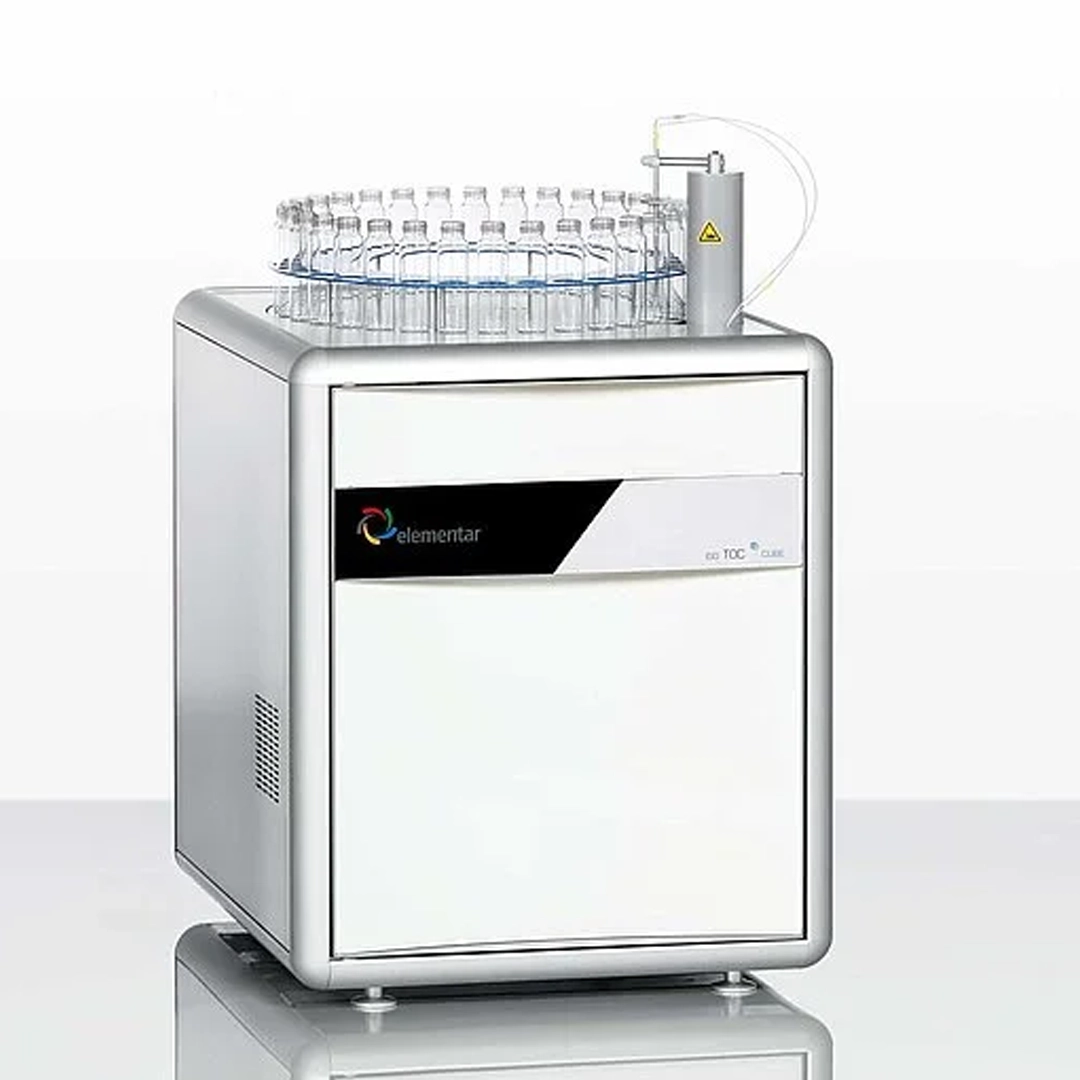
Elemental analyzer inlet for EA-IRMS
What is the iso TOC cube?
The iso TOC cube is an elemental analyzer designed for isotope ratio mass spectrometry (EA-IRMS), enabling the quantitative and isotopic analysis of dissolved total organic carbon (TOC) and total bound nitrogen (TNb) in aqueous samples.
Stable isotope analysis of dissolved carbon and nitrogen plays a key role in understanding biogeochemical cycling in aquatic systems. As dissolved matter represents a major pathway in these cycles, accurate quantification and isotope ratio analysis are essential.
The iso TOC cube introduces a high-temperature combustion method for this purpose and is the only commercially available instrument capable of performing both TOC and TNb isotope ratio analysis directly in liquid samples.
How does it perform TOC isotope analysis?
The iso TOC cube uses high-temperature combustion instead of wet-chemical or UV oxidation methods. This approach ensures complete conversion of all compounds, including refractory substances such as humic acids and lignin.
As a result, the system provides:
- Matrix-independent measurements
- High precision and accuracy across diverse liquid types
- Reliable performance for difficult-to-combust samples
It supports a wide range of sample matrices, including drinking water, wastewater, soil leachates, suspensions, brines, and marine samples.
How is direct δ¹⁵N analysis of TNb achieved?
The iso TOC cube is the only system capable of direct δ¹⁵N isotope analysis of total bound nitrogen in aqueous samples.
This is achieved through:
- A dedicated Low Concentration Module (LCM)
- An integrated membrane degasser to remove dissolved N₂
- Cryogen-free thermoelectric cooling combined with Advanced Purge and Trap (APT) technology
These features enable TNb detection levels down to 25 ppm and ensure clean separation of nitrogen signals.
High throughput without sample preparation
The iso TOC cube performs direct analysis of liquid samples, eliminating the need for time-consuming pre-treatment steps such as freeze drying.
This approach ensures:
- Direct determination of dissolved carbon and nitrogen
- Complete quantitative conversion of all compounds
- Faster workflows
- Reduced manual handling
- Unattended 24/7 operation
Designed for ease of use and uptime
The instrument is built for reliable long-term operation with minimal maintenance.
Key design features:
- Integrated autosampler with 32 positions (optional 50 positions)
- Reloadable during operation
- Tool-free maintenance via clamp connections
- Slide-out furnace for easy accessibility
- SALTTRAP technology for high-salinity samples
These features contribute to high system uptime and simplified daily operation.
Which parameters and isotopes can be analyzed?
The iso TOC cube is optimized for:
- δ¹³C
- δ¹⁵N (optional)
For the analysis of:
- Total Organic Carbon (TOC)
- Total Inorganic Carbon (TIC)
- Total Carbon (TC)
- Total Bound Nitrogen (TNb)
Analytical capabilities and performance
The iso TOC cube supports a wide range of concentrations and sample types, from trace levels to high concentrations and from freshwater to highly saline matrices.
- 100% carbon and nitrogen recovery independent of matrix
- Simultaneous δ¹³C and δ¹⁵N analysis at low concentration levels
- Typical detection levels down to:
- ~1 mg/L for carbon
- ~15 mg/L for nitrogen
It supports liquid injection volumes of up to 3 ml.
Which applications and sample types are supported?
The iso TOC cube is suitable for a wide range of laboratories and research environments:
- Environmental laboratories
- Academic research groups
- Quality control laboratories
- Contract laboratories
Typical sample types:
- Drinking water
- Seawater
- Wastewater (influent and effluent)
- Brines
- Soil leachates
Analytical specifications
| Maximum sample volume | Volume injections up to 3 ml for optimal detection |
|---|---|
| Element concentration range | Dissolved carbon: 5 ppm to 60,000 ppm Dissolved nitrogen*: 25 ppm to 60,000 ppm |
| Precision – elemental (external, 1σ) | Carbon: < 2 % relative Nitrogen*: < 2 % relative |
| Precision – isotope ratios (external, 1σ) | δ¹³C: 0.1 ‰ δ¹⁵N*: 0.2 ‰ |
| Analysis time | ~ 5 min in C mode ~ 15–20 min in CN mode* |
| Note | Analysis time depends on sample type, analysis mode, and configuration |
* optionally available