 English
 Dutch
 French

Kjeldahl vs. Dumas
Which nitrogen determination method is right for your lab?
Which nitrogen determination method is right for your lab?
Nitrogen determination is essential in food and feed testing, agriculture, environmental laboratories, and chemical manufacturing. But how do you decide which method to use: Kjeldahl or Dumas? Both methods provide reliable nitrogen measurements, yet they differ in speed, safety, analytical principle, and the nitrogen compounds they measure.
What is the Kjeldahl method?
The Kjeldahl method was introduced in 1883 and remains a widely used reference technique for nitrogen and protein determination. It measures organic nitrogen and ammonium nitrogen in samples such as food, animal feed, and agricultural materials.
The method is recognized in numerous standardized analytical procedures, including AOAC and ISO methods.
How does the Kjeldahl method work?
The Kjeldahl method consists of three main steps:
Digestion: the sample is heated with concentrated sulfuric acid, typically at approximately 400°C. This converts organic nitrogen into ammonium sulfate.
Distillation: sodium hydroxide is added to release ammonia, which is separated through distillation and collected in a receiving solution.
Titration: The collected ammonia is quantified through titration to calculate the nitrogen content.
The measured nitrogen content can then be converted into crude protein content using an appropriate conversion factor.
What are the advantages of the Kjeldahl method?
Kjeldahl’s main strength lies in its long-standing validation, particularly for food and feed protein determination.
Its advantages include:
Established reference method: widely recognized in standardized analytical procedures.
Reliable results: suitable for routine protein determination in many food and feed matrices.
Existing laboratory infrastructure: laboratories with Kjeldahl equipment can continue using validated workflows.
Established conversion factors: many protein determination methods use factors historically associated with Kjeldahl analysis.
What are the limitations of the Kjeldahl method?
Despite its widespread use, Kjeldahl has several limitations:
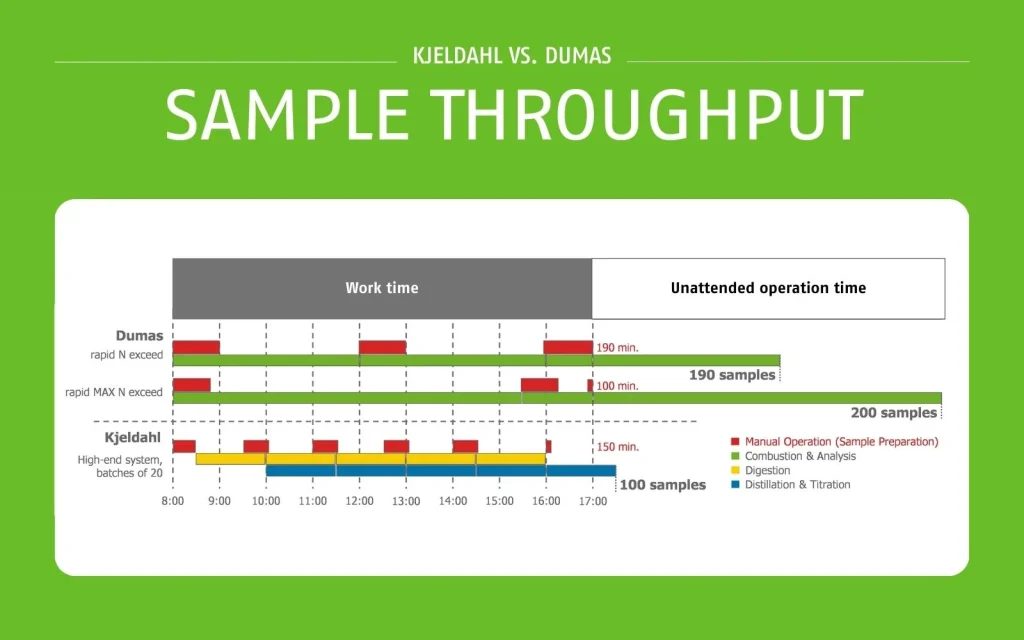
Longer analysis time: digestion, distillation, and titration can take several hours.
Hazardous chemicals: the method requires concentrated sulfuric acid, sodium hydroxide, and often catalysts.
Chemical waste: reagents and digestion residues require appropriate handling and disposal.
Limited nitrogen coverage: conventional Kjeldahl does not fully determine nitrate and nitrite nitrogen without additional treatment.
Manual handling: automation is available, but the process involves multiple preparation and analysis stages.
These limitations can make Kjeldahl less practical for laboratories processing large sample volumes.
What is the Dumas method?
The Dumas method, also known as the Dumas combustion method, determines nitrogen through high-temperature combustion. Unlike Kjeldahl, Dumas does not require wet chemical digestion. Instead, the sample undergoes combustion in an oxygen-rich environment.
Dumas analysis is widely used for nitrogen and crude protein determination in food, animal feed, agricultural products, and other materials.
How does the Dumas method work?
The Dumas method typically involves four steps:
Combustion: the sample is combusted at high temperatures, often around 900–1000°C, in an oxygen-rich environment.
Gas conversion: nitrogen-containing compounds form nitrogen oxides and other combustion products.
Reduction and purification: nitrogen oxides are reduced to molecular nitrogen (N₂). Other combustion products are removed.
Detection: a thermal conductivity detector measures the nitrogen gas to determine the sample’s nitrogen content.
The measured nitrogen content can then be used to calculate crude protein content. Because the process is highly automated, modern Dumas analyzers can process samples with minimal operator intervention.
What are the advantages of the Dumas method?
The Dumas method offers several benefits for laboratories seeking faster and more automated nitrogen analysis.
Fast analysis: many modern Dumas analyzers complete a measurement in approximately 3–5 minutes.
No hazardous wet chemicals: the method eliminates concentrated acids and alkalis from the analytical procedure.
High automation: automated sample handling supports laboratories with high sample throughput.
Broad nitrogen determination: Dumas measures total nitrogen, including many inorganic nitrogen compounds.
Reduced chemical waste: combustion analysis avoids the acidic liquid waste associated with Kjeldahl digestion.
These advantages make Dumas particularly attractive for laboratories that prioritize productivity, safety, and efficient sample processing.
What are the limitations of the Dumas method?
Despite its advantages, Dumas analysis also has limitations.
Higher initial investment: automated combustion analyzers may require greater upfront investment.
Gas consumption: the method requires oxygen and suitable carrier gases.
Routine maintenance: combustion components, consumables, and gas purification systems require maintenance.
Sample considerations: sample size and sample homogeneity can affect the representativeness of the results.
Laboratories should evaluate these factors alongside their analytical requirements and expected sample throughput.
Comparison of the Dumas and Kjeldahl method
Feature | Kjeldahl Method | Dumas Method |
Principle | Wet chemistry (digestion–distillation–titration) | High‑temperature combustion |
Nitrogen detected | Organic nitrogen only | Total nitrogen (organic + inorganic) |
Typical analysis time | 2–4 hours | 3–5 minutes |
Chemicals required | Sulfuric acid, sodium hydroxide, catalysts | None (only gases) |
Automation | Limited | Fully automated |
Safety & environment | Chemical waste, corrosive reagents | Low waste, safer process |
Instrument cost | Lower | Higher |
Operating cost | Moderate (reagents, waste disposal) | Low (mainly gases) |
Best suited for | Regulated food/feed protein | High-throughput labs, total N |
Kjeldahl vs. Dumas: which method is more accurate?
Both Kjeldahl and Dumas can provide accurate and reproducible nitrogen measurements when laboratories use validated procedures. However, their results are not always identical.
Dumas may produce slightly higher nitrogen values because it measures a broader range of nitrogen compounds. Conventional Kjeldahl does not fully recover certain inorganic nitrogen forms, including nitrate and nitrite. The difference depends on the sample composition and the amount of non-protein nitrogen present.
Neither method directly measures protein molecules. Instead, both determine nitrogen content, which laboratories can use to estimate crude protein. Therefore, method selection should consider the analytical standard, sample matrix, and required reporting method rather than speed alone.
How is protein content calculated from nitrogen determination?
Nitrogen determination plays an important role in protein analysis across the food and feed industries.
Both Kjeldahl and Dumas measure nitrogen rather than protein directly. Laboratories calculate crude protein content by multiplying the measured nitrogen percentage by a conversion factor.
Crude protein (%) = Nitrogen (%) × Conversion factor
A commonly used conversion factor is 6.25, based on the assumption that proteins contain approximately 16% nitrogen.
For example, a sample containing 2% nitrogen would have an estimated crude protein content of:
2% × 6.25 = 12.5% crude protein
However, the appropriate conversion factor depends on the sample type and analytical standard. Some products require different factors because their proteins have different nitrogen compositions.
Neither method distinguishes protein nitrogen from all non-protein nitrogen. Therefore, the calculated crude protein value does not necessarily represent the exact amount of true protein.
This distinction is particularly relevant when analyzing complex food products, plant-based proteins, and other materials containing non-protein nitrogen compounds.
When is Kjeldahl the best choice for nitrogen determination?
Kjeldahl remains a suitable choice for laboratories working with established nitrogen and protein determination methods.
It is particularly useful when:
Regulatory compliance requires Kjeldahl: certain analytical standards specify Kjeldahl as the required method.
Samples contain mainly organic nitrogen: common applications include dairy products, meat, cereals, beverages, and animal feed.
Existing laboratory equipment is available: laboratories can continue using established Kjeldahl workflows.
Sample throughput is relatively low: longer processing times may be acceptable for smaller sample volumes.
Kjeldahl remains particularly valuable in traditional protein analysis and applications that require method-specific validation.


When is Dumas the best choice for nitrogen determination?
Dumas is particularly suitable for laboratories that require rapid, automated nitrogen analysis.
It is ideal for:
High-throughput laboratories: fast analysis supports routine testing of large sample volumes.
Food and feed quality control: automated nitrogen determination supports consistent product testing.
Laboratories prioritizing safety: the method avoids concentrated acids and chemical digestion.
Environmental and agricultural testing: total nitrogen determination is useful for suitable soil, fertilizer, and other sample matrices.
Laboratories reducing chemical waste: combustion eliminates the need for acidic digestion waste.
Its speed and automation can justify the higher initial investment, especially when laboratories analyze many samples every day.
What should laboratories consider when choosing between Kjeldahl and Dumas?
Before selecting a nitrogen determination method, laboratories should evaluate several practical factors.
1. Analytical requirements
Check whether the applicable standard specifies Kjeldahl, Dumas, or permits both methods. The required procedure may depend on the sample matrix and industry.
2. Sample throughput
For laboratories processing many samples daily, Dumas can significantly reduce analysis time and manual handling.
3. Sample composition
Consider whether the sample contains inorganic nitrogen compounds that conventional Kjeldahl may not fully recover.
4. Laboratory safety
Kjeldahl requires chemical digestion and appropriate waste management. Dumas avoids hazardous wet chemical reagents but requires high-temperature equipment and gas handling.
5. Total cost of ownership
Compare equipment investment, consumables, gas consumption, labor requirements, maintenance, and waste disposal costs.
A method that requires higher initial investment may offer operational advantages over time, depending on laboratory workload.
Discuss your application with our Xperts
Our Xperts are happy to discuss your application and help you find the right solution.
FAQ
What is the main difference between Kjeldahl and Dumas?
Kjeldahl determines nitrogen through chemical digestion, distillation, and titration. Dumas uses high-temperature combustion and gas detection. Dumas is generally faster and measures a broader range of nitrogen compounds.
Is the Dumas method better than Kjeldahl?
Not necessarily. Dumas offers advantages in speed, automation, and chemical waste reduction. However, Kjeldahl remains important when analytical standards specifically require it.
Does the Dumas method measure protein directly?
No. Dumas measures nitrogen content. Laboratories calculate crude protein using an appropriate nitrogen-to-protein conversion factor. Kjeldahl follows the same general principle.
Which method is faster, Kjeldahl or Dumas?
Dumas is generally faster, with many modern instruments completing analysis in approximately 3–5 minutes. A complete Kjeldahl workflow often takes several hours, although automation and batch processing can improve productivity.
Why can Dumas give higher nitrogen results than Kjeldahl?
Dumas generally measures a broader range of nitrogen compounds, including inorganic nitrogen. Conventional Kjeldahl does not fully recover nitrate and nitrite without additional treatment.
