 English
 Dutch
 French

Continuous flow analyzers
Continuous flow analyzers automate colorimetric wet-chemistry methods for nutrient and chemical analysis. They continuously pump samples and reagents through a chemistry manifold, allowing multiple samples to be analyzed with high throughput and reproducibility.
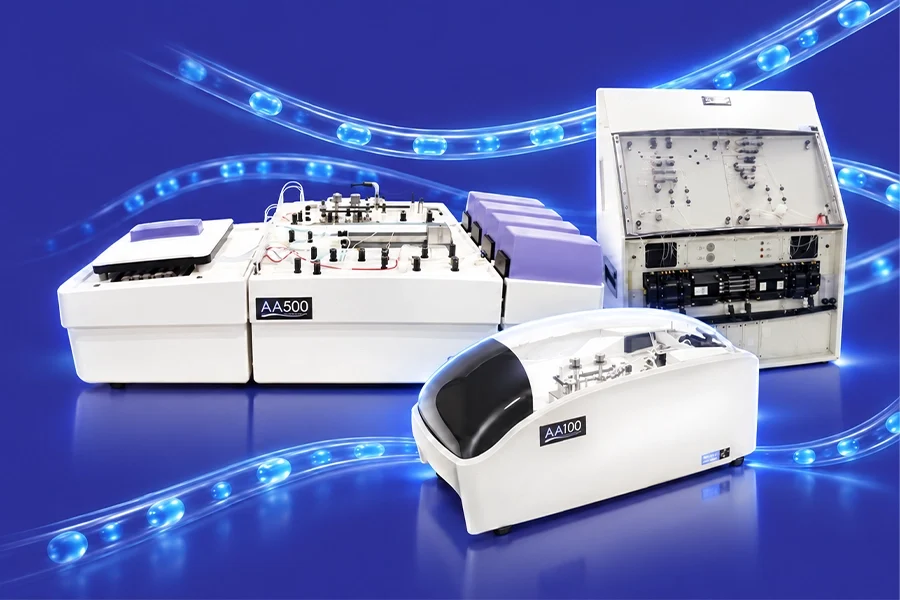
What is continuous flow analysis?
Continuous flow analysis is an automated analytical technique in which samples and reagents move continuously through a system of tubes, mixing coils and reaction modules.
Our systems use segmented flow analysis, or SFA. Air bubbles are introduced into the liquid stream at regular intervals, dividing it into individual reaction segments.
These air bubbles help to:
- Separate consecutive samples
- Reduce sample carryover
- Improve the mixing of samples and reagents
- Clean the inner surfaces of the tubing
- Stabilize reaction conditions
As the segmented stream passes through the manifold, the chemical reaction develops under controlled conditions. The resulting colour is measured photometrically and converted into an analyte concentration.

Continuous flow versus discrete analysis
Continuous flow and discrete analyzers both automate colorimetric wet-chemistry methods, but they handle reactions differently.
A continuous flow analyzer pumps samples and reagents through a manifold. Air bubbles divide the liquid stream into segments, and reactions develop while flowing through the system.
A discrete analyzer prepares each reaction separately in an individual reaction well. The completed solution is then transferred to a cuvette for measurement.
Continuous flow analysis is particularly suitable for repetitive, high-throughput testing and methods requiring integrated sample pretreatment. Discrete analysis provides flexibility when different combinations of tests must be assigned to individual samples.
The most appropriate technique depends on the methods, sample volume, concentration range and laboratory workflow.
How does a continuous flow analyzer work?
Samples are placed in an autosampler and assigned to an analytical sequence. A peristaltic pump continuously moves samples, reagents and wash solutions through the system.
The sample stream is divided into segments by regularly introduced air bubbles. Reagents are added at defined points, and the segments pass through glass mixing coils and other components required by the method.
Depending on the analysis, the system can incorporate inline operations such as:
- Heating
- Dialysis
- Dilution
- Gas diffusion
- Distillation
- Digestion
Once the colour reaction has developed, the solution passes through a flow cell. A photometer measures the absorbance, and the software compares the response with a calibration to calculate the concentration.
Multiple channels can analyze different parameters from the same sample simultaneously.
Applications of continuous flow analysis
Continuous flow analyzers are used in environmental, agricultural, industrial and research laboratories.
Common applications include:
- Drinking water
- Municipal and industrial wastewater
- Surface water and groundwater
- Seawater and brackish water
- Soil and plant extracts
- Fertilizers
- Tobacco
- Food and beverages
- Wine
- Industrial process samples
- Environmental research
Available methods cover nutrients and other colorimetric parameters such as ammonia, nitrate, nitrite, phosphate, silicate, chloride, alkalinity, total Kjeldahl nitrogen and total phosphorus.
The precise method, detection range and sample preparation requirements depend on the sample matrix and analytical standard.

Advantages of segmented flow analysis
Simultaneous multi-parameter analysis
Multi-channel systems can divide one sample between several analytical channels. This allows different parameters to be measured simultaneously.
Complete reaction development
The sample and reagents remain within controlled reaction segments while moving through the manifold. The method can therefore provide sufficient time for the color reaction to develop before measurement.
Inline sample preparation
Operations such as dialysis, dilution, digestion, gas diffusion and distillation can be integrated into the analytical flow path. This reduces the amount of manual sample preparation required.
Low detection limits
Stable reaction conditions and high-resolution photometric detection support sensitive measurements, including low-level nutrient analysis.
High sample throughput
Continuous sample introduction enables large batches to be processed efficiently. Throughput depends on the selected method, channel configuration and required reaction time.
Choosing a continuous flow analyzer
Number of analytical channels
A laboratory performing one or two dedicated methods may only require a dual-channel system. Laboratories measuring several parameters simultaneously need a larger multi-channel configuration.
Sample throughput
The required daily sample capacity helps determine the most appropriate system. High-volume laboratories may benefit from a microflow analyzer with several channels operating simultaneously.
Detection requirements
Applications such as seawater analysis can require very low detection limits. The selected analyzer, detector and method must be appropriate for the expected concentration range.
Sample preparation
Complex samples may require dialysis, digestion, dilution, gas diffusion or distillation. Integrating these operations into the analyzer can reduce manual preparation and simplify the workflow.
Method flexibility
A laboratory performing changing combinations of analyses may benefit from configurable channels and multitest manifolds. Dedicated laboratories may prefer a simpler system configured for one or two established methods.
Automation
Automated startup, shutdown, rinsing and over-range dilution can reduce operator involvement. These functions are particularly valuable for long sample sequences and unattended operation.
Frequently asked questions
What is a continuous flow analyzer?
A continuous flow analyzer automatically pumps samples and reagents through a chemistry manifold. Reactions develop while the liquid moves through the system, after which a detector measures the resulting colour.
What is segmented flow analysis?
Segmented flow analysis is a form of continuous flow analysis in which air bubbles divide the liquid stream into separate reaction segments. The bubbles improve mixing, reduce carryover and help maintain consistent reaction conditions.
Which parameters can a continuous flow analyzer measure?
Continuous flow analyzers can measure many nutrients and other colorimetric parameters. Examples include ammonia, nitrate, nitrite, phosphate, silicate, chloride, alkalinity and total Kjeldahl nitrogen.
Can several parameters be measured simultaneously?
Yes. A multi-channel analyzer can divide the same sample between different analytical channels, allowing several parameters to be measured simultaneously.
What is inline sample preparation?
Inline sample preparation means that an operation such as dialysis, dilution, digestion, gas diffusion or distillation takes place within the analyzer’s flow path. This reduces the need for separate manual preparation.
What is the difference between segmented flow and flow injection analysis?
Both are forms of continuous flow analysis. Segmented flow analysis introduces air bubbles into the stream, while flow injection analysis uses an unsegmented flowing carrier solution. The techniques use different reaction and signal-processing approaches.
Which continuous flow analyzer should I choose?
The AA100 is suitable for one or two dedicated methods. The QuAAtro39 is intended for compact, high-throughput microflow analysis. The AA500 offers the greatest automation and flexibility for multi-channel methods and advanced inline sample preparation.
Compare our continuous flow analyzers
SciSPX supplies continuous flow analyzers to laboratories in Belgium, the Netherlands and Luxembourg. The available systems use segmented flow analysis and range from compact two-channel configurations to fully automated multi-channel analyzers.
Use the comparison below to identify which continuous flow analyzer best matches your laboratory workflow.
Analyzer | Maximum channels | Main configuration | Key advantage | Best suited for |
|---|---|---|---|---|
AA500 | Six or more | Modular multi-channel system | Extensive automation and method flexibility | Laboratories performing several methods or requiring advanced inline sample preparation |
QuAAtro39 | Up to five | Compact microflow system | Highest throughput with low reagent consumption | High-volume nutrient analysis and low-level applications |
AA100 | Up to two | Compact dual-channel system | Simple analysis of one or two dedicated methods | Smaller laboratories and dedicated routine testing |
The QuAAtro39 can process most methods at approximately 100 to 120 samples per hour per channel. A five-channel configuration can perform up to 600 tests per hour. Actual throughput depends on the analytical method and system configuration.
Find the right continuous flow analyzer
Selecting a continuous flow analyzer starts with defining the parameters, concentration ranges, sample matrices and daily workload. The required number of channels and need for inline sample preparation should also be considered.
We can help you compare the available systems and select a configuration suited to your methods and laboratory workflow.

Fully automated
AA500
Modular, highly automated segmented flow analyzer with six or more channels. It supports simultaneous multi-parameter analysis and advanced inline sample preparation.

High-throughput microflow
QuAAtro39
Compact microflow analyzer designed for high-speed, low-level analysis. Configurations with up to five channels can perform as many as 600 tests per hour.

Compact dual-channel
AA100
Compact continuous flow analyzer for one or two dedicated methods. It combines a small footprint with automated colorimetric analysis and inline sample-preparation options.
Not sure which analyzer fits your application?
Our Xperts are happy to discuss your application and help you find the right solution.
