 English
 Dutch
 French

Ash analysis
Ash analysis determines the inorganic residue remaining after a sample has been heated under controlled conditions. The result can provide information about mineral content, inorganic components, fillers, contamination or product composition.
What is ash analysis?
Ash analysis measures the residue that remains after combustible and volatile components have been removed from a sample by heating. Depending on the sample and analytical method, this residue may contain minerals, metal oxides, salts, fillers or other inorganic substances.
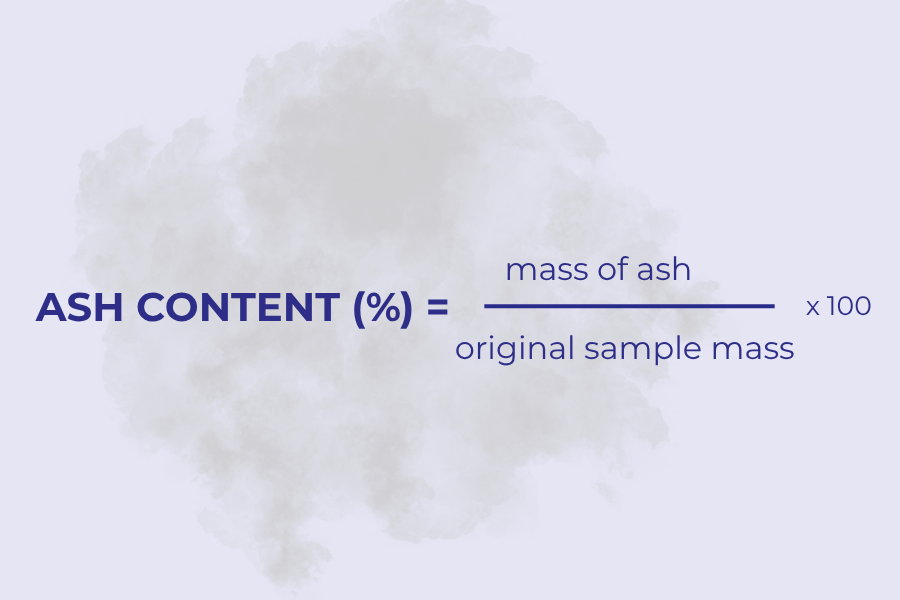
The ash content is generally calculated by comparing the mass of the remaining residue with the original sample mass. It is commonly expressed as a percentage:
Ash content (%) = mass of ash ÷ original sample mass × 100
Ash analysis is used for quality control, product characterization, formulation checks and verification against analytical specifications. The required temperature and heating programme depend on the sample and applicable method.
What is sulfated ash analysis?
Sulfated ash analysis determines the non-volatile residue remaining after a sample has been treated with sulfuric acid and ignited under defined conditions. The acid converts certain inorganic components into more stable sulfate salts before the final residue is weighed.
The process generally includes an initial controlled heating stage followed by heating at a higher temperature. Careful temperature control is important because some samples can foam, spatter or release corrosive vapours during preparation.
Sulfated ash analysis is used for materials such as pharmaceuticals, active pharmaceutical ingredients, excipients, lubricating oils, polymers, rubber and industrial chemicals. It may also be referred to as a residue-on-ignition test, depending on the applicable method.
Ash content, loss on ignition and residue on ignition
Several related measurements use controlled heating, but they do not necessarily represent the same analytical result.
Ash content
Ash content represents the residue remaining after the combustible components of a sample have been removed. It is frequently used for food, feed, polymers, chemicals, petroleum products and other materials.
Loss on ignition
Loss on ignition, or LOI, measures the mass lost when a sample is heated under specified conditions. This loss may include moisture, organic matter, carbon dioxide or other volatile substances, depending on the material and method.
Residue on ignition
Residue on ignition, or ROI, determines the non-volatile residue remaining after ignition. The procedure is commonly used for pharmaceutical substances, excipients and chemical materials.
The terminology, heating conditions and calculation must follow the applicable analytical method. Ash content, loss on ignition and residue on ignition should therefore not be treated as interchangeable results.
How does an ash analysis system work?
A weighed sample is placed in a suitable crucible and heated inside a muffle furnace. During heating, organic and volatile components are removed while non-combustible material remains in the crucible.
After the ashing process, the residue is weighed. The difference between the initial sample mass and the remaining residue is used to calculate the ash content or another method-specific result.
Modern ash analysis systems allow laboratories to program temperature ramps and holding times. Rapid furnace heating and controlled ventilation can reduce analysis time and simplify the workflow compared with a conventional muffle furnace.
The selected procedure must correspond with the sample type and analytical standard. Temperature, ashing time, crucible material and sample preparation can all influence the result.
Applications of ash analysis
Ash analysis is used across food, pharmaceutical, chemical and industrial laboratories.
Common applications and sample types include:
- Food and animal feed
- Pharmaceuticals, APIs and excipients
- Chemicals and raw materials
- Plastics and polymers
- Rubber and elastomers
- Lubricating oils, mineral oils and petroleum products
- Biomass, wood, pulp and paper
The required system and analytical method depend on the sample composition, expected residue, heating temperature and need for acid treatment.

Choosing an ash analysis system
Several analytical and practical factors should be considered when selecting a system.
Type of analysis
General ash determination can be performed with a programmable muffle furnace. Applications requiring sulfuric-acid treatment and controlled staged heating benefit from a system designed specifically for sulfated ash analysis.
Sample composition
Foods, feeds, chemicals, plastics, pharmaceuticals and petroleum products behave differently during heating. Samples with high organic content or volatile components may require controlled temperature ramps and effective ventilation.
Required temperature
The selected furnace must reach and maintain the temperature specified by the analytical method. Different applications can require substantially different ashing temperatures.
Sample throughput
Laboratories processing multiple samples should consider furnace capacity, heating time, crucible size and cooling time. Programmable methods can reduce operator involvement during routine analysis.
Crucible compatibility
The crucible material must be suitable for the sample, temperature and analytical method. Depending on the application, laboratories may use quartz-fibre, porcelain, platinum, nickel or other crucibles.
Analytical methods and validation
The programmed temperature, ramp rate and holding time must correspond with the applicable method. Laboratories operating under regulated conditions should also consider temperature verification, calibration, audit trails and qualification requirements.
Frequently asked questions
What does ash content indicate?
Ash content indicates the amount of non-combustible residue remaining after a sample has been heated under specified conditions. Depending on the material, this residue may contain minerals, salts, metal oxides, fillers or other inorganic components.
How is ash content calculated?
The residue remaining after ashing is weighed and compared with the original sample mass. Ash content is generally reported as the mass of the residue divided by the original sample mass, multiplied by 100.
What is the difference between ash content and sulfated ash?
General ash analysis heats the sample according to a defined furnace method and measures the remaining residue. Sulfated ash analysis includes treatment with sulfuric acid before or during ignition, converting certain inorganic components into sulfate salts.
Is loss on ignition the same as ash content?
No. Ash content measures the residue remaining after heating, while loss on ignition measures the mass lost during heating. The two values describe different parts of the sample and must be interpreted according to the applicable method.
Which samples can be analyzed for ash content?
Ash analysis can be performed on many materials, including food, feed, pharmaceuticals, chemicals, polymers, rubber, oils, petroleum products, biomass, pulp and paper. The heating programme and crucible must be appropriate for the sample and method.
Our ash analysis systems
SciSPX supplies ash analysis systems for general and sulfated ash determination. The systems differ mainly in their intended analysis, heating workflow and management of vapours.
Use the comparison below to identify which system best matches your analytical requirements.
System | Main analysis | Maximum temperature | Sample capacity | Main features | Best suited for |
|---|---|---|---|---|---|
Phoenix BLACK | General ash content, loss on ignition and method-dependent residue on ignition | Up to 1,200 °C with the high-temperature insert | Up to 15 samples with the high-capacity insert, depending on crucible size | Programmable temperature ramps, rapid heating and compatibility with conventional crucible types | Rapid routine ash analysis across varied samples |
Phoenix BLACK Sulfated Ash | Sulfated ash and residue on ignition | Method-dependent programmed heating | Depends on the selected crucibles and configuration | Automated staged heating with vapour removal and neutralization | Pharmaceuticals, excipients, chemicals, oils, polymers and other sulfated-ash applications |
Find the right ash analysis system
Selecting an ash analysis system starts with defining the required test method, sample type, ashing temperature and expected throughput. It is also important to determine whether the procedure involves direct furnace ashing or sulfuric-acid treatment.
We can help you compare our systems and select a configuration suited to your analytical requirements.

General ash content
Phoenix BLACK
A programmable muffle furnace for rapid ash analysis. It supports temperatures up to 1,200 °C and can process multiple samples simultaneously.

Sulfated ash
Phoenix BLACK Sulfated Ash
automates sulfated ash and residue-on-ignition procedures. Its integrated system removes and neutralizes acid vapours during analysis.
Not sure which system fits your application?
Our Xperts are happy to discuss your application and help you find the right solution.
