 English
 Dutch
 French

Amylose vs. Amylopectin
Starch consists of two glucose-based polymers: amylose and amylopectin.
Two glucose-based polymers
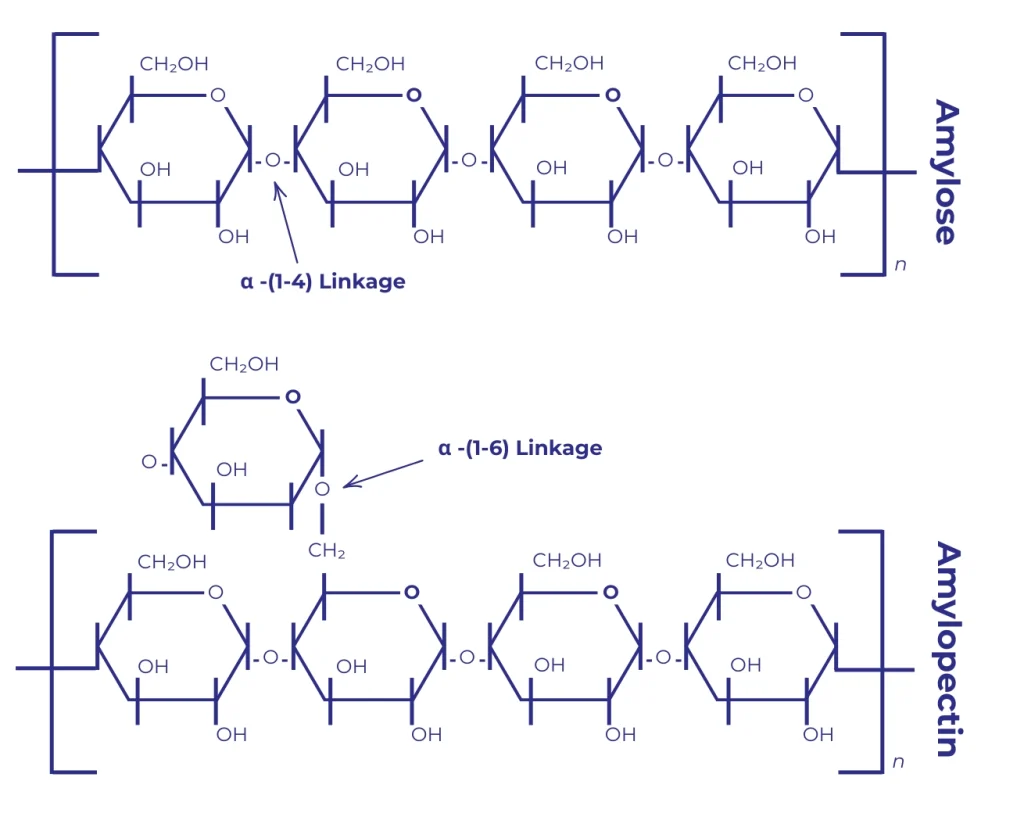
Starch consists of two glucose-based polymers: amylose and amylopectin. Although both are made of glucose, their molecular structures differ significantly. Amylose is predominantly linear, while amylopectin is highly branched. This structural difference affects how they behave in food: amylose is associated with stronger gel formation, firmer textures, and faster retrogradation, while amylopectin contributes to higher viscosity, softer textures, and greater freeze-thaw stability.
What is amylose?
Amylose is a predominantly linear molecule in which glucose units are linked by α-(1→4) bonds. Because of its relatively straight structure, amylose molecules can align and reassociate during cooling, leading to the formation of firm gels.
High-amylose starches are associated with:
- Strong gel formation
- Firm textures
- Film-forming properties
- Increased resistant starch content
- Faster retrogradation
These characteristics make high-amylose starches suitable for applications requiring structure, firmness, or fibre enrichment
What is amylopectin?
Amylopectin is a highly branched molecule containing both α-(1→4) and α-(1→6) bonds. Its branched structure limits reassociation after gelatinization, resulting in softer and more stable textures.
High-amylopectin starches are associated with:
- High viscosity
- Smooth mouthfeel
- Excellent freeze-thaw stability
- Reduced retrogradation
- Clearer pastes
Waxy starches, which consist almost entirely of amylopectin, are widely used in frozen foods, fruit fillings, sauces, and other applications where stability is critical.
Key differences
Property | Amylose | Amylopectin |
Structure | Predominantly linear | Highly branched |
Gel formation | Strong | Limited |
Texture | Firm | Soft and cohesive |
Viscosity | Moderate | High |
Retrogradation | Fast | Slow |
Freeze–thaw stability | Lower | Higher |
Resistant starch potential (CRS) | Higher | Lower |
Why does the amylose-to-amylopectin ratio matter?
The ratio of amylose to amylopectin is one of the most important factors determining starch functionality.
- High-amylose starches create firmer textures and stronger gels.
- High-amylopectin (waxy) starches provide greater viscosity and stability.
- Standard starches offer a balance between gel strength and thickening performance.
As a result, starch selection depends heavily on the final product. Bakery products, frozen foods, confectionery, dairy alternatives, and sauces all require different amylose-to-amylopectin ratios to achieve the desired texture and shelf life.
Impact on food texture
The amylose-to-amylopectin ratio directly affects the sensory properties of food products. High-amylose systems generally produce firmer textures and stronger gels, while high-amylopectin systems create a smoother, creamier mouthfeel with greater viscosity.
This balance influences key quality attributes such as crumb softness in bakery products, freeze-thaw stability in frozen foods, gel strength in confectionery, and creaminess in dairy alternatives.
What is resistant starch (RS)?
Resistant starch (RS) is the fraction of starch that resists digestion in the small intestine and reaches the large intestine, where it is fermented by the gut microbiota. Because it behaves similarly to dietary fibre, resistant starch has gained significant interest in both nutrition research and food product development.
In addition to its potential health benefits, resistant starch is increasingly used in food formulations to improve fibre content while maintaining desirable texture and sensory properties.
Type | Description | Examples |
RS1 | Physically inaccessible starch | Whole grains, legumes, seeds |
RS2 | Native starch granules that are resistant to amylase digestion in their raw state | Raw potato, green banana, high-amylose maize |
RS3 | Retrograded starch formed after cooking and cooling | Cooked-then-cooled potatoes, rice, bread |
RS4 | Chemically modified starch | Selected modified food starches |
RS5 | Amylose-lipid complexes | Certain processed starch-containing foods |
RS2 and RS3 are the most widely studied and commercially important forms of resistant starch.
Benefits of resistant starch
Resistant starch functions similarly to dietary fibre and has been associated with several physiological benefits.
Potential benefits include:
- Reduced post-meal blood glucose response
- Fermentation by beneficial gut microorganisms
- Production of short-chain fatty acids such as butyrate
- Support of gut health and microbiome diversity
- Increased satiety
- Reduced caloric contribution compared with digestible starch
These properties have made resistant starch an attractive ingredient for fibre enrichment, sugar reduction strategies, and functional food development.
Learn more about starch analysis
Discuss your food analysis requirements
Our Xperts are happy to discuss your application and help you find the right solution.
FAQ
What is the difference between amylose and amylopectin?
Amylose and amylopectin are the two main components of starch. Amylose has a predominantly linear structure made of glucose units linked by α-(1→4) bonds, while amylopectin has a highly branched structure containing both α-(1→4) and α-(1→6) bonds. These structural differences result in different functional properties in food products.
Which starch component is responsible for gel formation?
Amylose is primarily responsible for gel formation. Its linear chains can reassociate after gelatinization, creating a network that contributes to firmness and structure.
Which starch component provides higher viscosity?
Amylopectin generally provides higher viscosity because its branched structure promotes extensive swelling during gelatinization while maintaining a smooth texture.
Which starch has better freeze-thaw stability?
Amylopectin-rich starches generally have superior freeze-thaw stability because they resist molecular reassociation and water separation during storage.
Which starch retrogrades faster?
Amylose retrogrades faster than amylopectin. Its linear chains can realign quickly after gelatinization, leading to firmer textures during storage.
How does resistant starch differ from regular starch?
Regular starch is digested and absorbed in the small intestine, providing glucose for energy. Resistant starch escapes digestion and behaves more like dietary fiber.
What are the different types of resistant starch?
Resistant starch is generally classified into five types. RS1 consists of physically inaccessible starch found in whole grains and seeds. RS2 includes naturally resistant raw starches such as green bananas and high-amylose maize. RS3 forms when cooked starches are cooled and retrograde. RS4 consists of chemically modified starches. RS5 is formed by amylose-lipid complexes.
What foods naturally contain resistant starch?
Natural sources of resistant starch include legumes, whole grains, seeds, green bananas, raw potatoes, and certain high-amylose maize varieties.
Can cooking affect resistant starch content?
Yes. Cooking generally reduces resistant starch, but cooling cooked starch-containing foods such as rice, potatoes, and bread can increase resistant starch through the formation of RS3.
Why do cooled potatoes and rice contain more resistant starch?
When cooked starch cools, some starch molecules reorganize into structures that resist digestion. This process is called retrogradation and results in the formation of resistant starch type RS3.
