 English
 Dutch
 French

Sources of starch
The most common commercial starch sources are corn, potato, wheat, tapioca, rice, and peas.
One of the most abundant molecules in the food industry
Starch is one of the most abundant, versatile, and scientifically fascinating molecules in the food industry. From the crumb of a sourdough loaf to the creaminess of a plant-based yogurt, from resistant fibre nutrition to analytical method development, starch is at the heart of it all. This resource covers everything you need to know: the science, the functionality, the modifications, and the measurement methods that matter in modern food analysis.
What is starch?
Starch is one of the most important ingredients in food manufacturing. It serves as a thickener, gelling agent, stabilizer, water binder, and texture modifier in a wide range of products, including bakery products, dairy alternatives, soups, sauces, snacks, and ready meals.
Chemically, starch is a carbohydrate composed of glucose units and functions as the primary energy storage molecule in plants. It is naturally found in cereals, potatoes, rice, legumes, and many other crops.
In its native form, starch is present as microscopic granules that are insoluble in cold water. When heated in the presence of water, these granules absorb moisture, swell, and gelatinize. This process is responsible for the thickening, gelling, and texture-building properties that make starch indispensable in food production.
Structure of starch
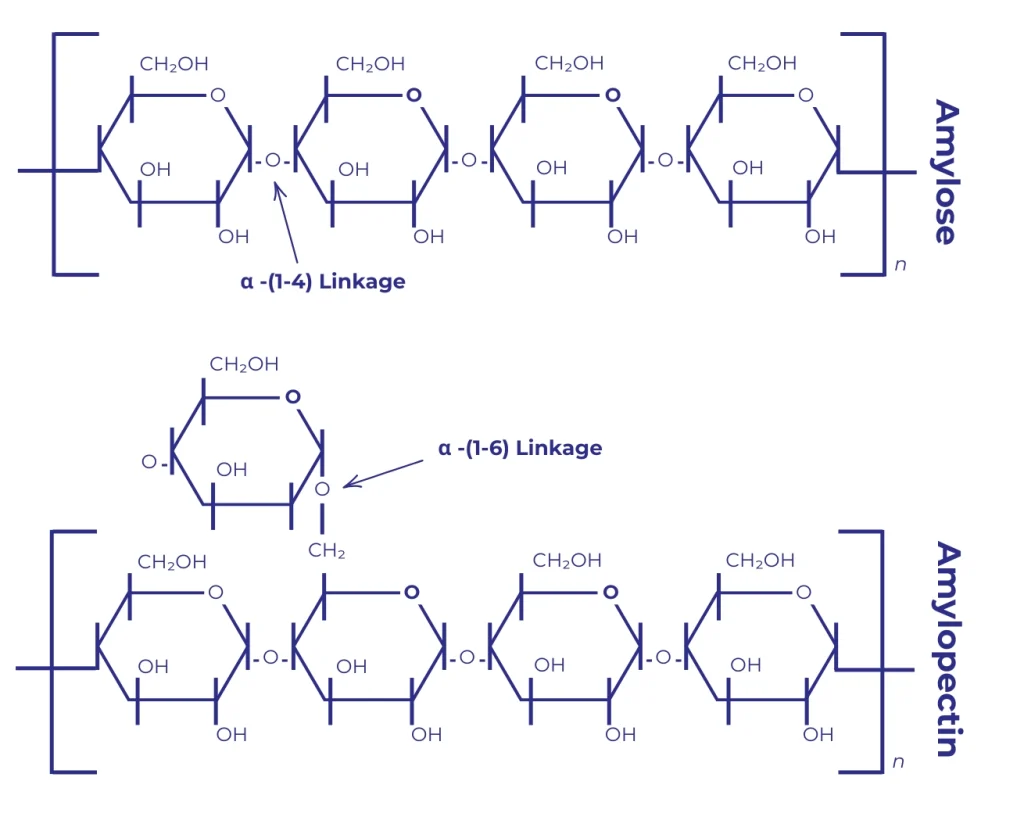
Starch granules are semi-crystalline structures with a complex internal architecture. Each granule consists of two distinct polymer fractions:
- Amylose: a largely linear chain of glucose units connected by α-(1→4) glycosidic bonds, forming a helical structure.
- Amylopectin: a highly branched polymer in which α-(1→4) linear chains are connected at branch points by α-(1→6) glycosidic bonds.
The ratio of amylose to amylopectin varies depending on the starch source and has a major impact on functionality, including viscosity, texture, freeze-thaw stability, and shelf life.
Why is starch important in food production?
Beyond its nutritional role, starch is used to control the texture and stability of food products. Depending on the starch source and processing conditions, it can:
- Increase viscosity in soups and sauces
- Improve water retention in bakery and meat products
- Create smooth, creamy textures in dairy alternatives
- Enhance freeze-thaw stability in frozen foods
- Contribute to gel formation and product structure
Because starch directly affects product quality, processability, and shelf life, it is one of the most frequently analysed components in food laboratories.
Sources of starch
Starch can be obtained from a wide range of botanical sources, each with distinct functional properties. Differences in amylose content, granule structure, and processing behaviour influence viscosity, texture, stability, and suitability for specific food applications.
The most common commercial starch sources are corn, potato, wheat, tapioca, rice, and peas.

Corn (maize) starch
Corn starch is the most widely produced starch in the world and remains the backbone of the global starch industry. It offers good thickening performance, neutral flavour, broad availability, and competitive cost.
Common applications include sauces, soups, confectionery, sweetener production, and industrial processes. Waxy corn starch, which consists almost entirely of amylopectin, is widely used in frozen foods and clear sauces because of its excellent freeze-thaw stability.

Potato starch
Potato starch is known for its exceptionally high viscosity, strong water-binding capacity, and clear pastes. These properties make it particularly attractive for applications where texture and moisture retention are critical.
It is commonly used in soups, sauces, coatings, gluten-free bakery products, and various industrial applications.

Wheat starch
Wheat starch is typically produced as a co-product of wheat gluten manufacturing. It provides moderate thickening properties and contributes to structure and texture in bakery products.
Common applications include bread, noodles, pasta, confectionery, and starch-derived sweeteners. Specially processed wheat starch may also be used in gluten-free products when regulatory requirements are met.

Tapioca starch
Derived from cassava roots, tapioca starch is valued for its neutral flavour, high paste clarity, and excellent freeze-thaw stability.
These properties make it a popular choice for sauces, gravies, gluten-free bakery products, processed meats, noodles, and clean-label formulations.

Rice starch
Rice starch has the smallest granule size of the major commercial starches, resulting in a smooth texture and bland flavour profile.
It is frequently used in baby food, gluten-free products, rice-based foods, pharmaceutical formulations, and specialty nutritional products.

Pea starch
Pea starch has gained importance with the growth of plant-based foods and pulse-derived ingredients. Its relatively high amylose content contributes to firm gel formation and good thickening performance.
Typical applications include plant-based meat products, dairy alternatives, snacks, coatings, and gluten-free bakery products. Pea starch is also increasingly valued for its sustainability profile and compatibility with plant-based product development.
Comparison of common starch sources
| Starch source | Key characteristics | Typical applications |
|---|---|---|
| Corn (maize) | Good thickening performance; neutral flavour; broad availability; competitive cost | Sauces, soups, confectionery, sweetener production, industrial processes |
| Waxy corn | Consists almost entirely of amylopectin; excellent freeze-thaw stability | Frozen foods, clear sauces |
| Potato | Exceptionally high viscosity; strong water-binding capacity; clear pastes | Soups, sauces, coatings, gluten-free bakery products, industrial applications |
| Wheat | Moderate thickening properties; contributes to structure and texture; typically a co-product of wheat gluten manufacturing | Bread, noodles, pasta, confectionery, starch-derived sweeteners; specially processed starch in some gluten-free products |
| Tapioca | Neutral flavour; high paste clarity; excellent freeze-thaw stability | Sauces, gravies, gluten-free bakery products, processed meats, noodles, clean-label formulations |
| Rice | Very small granule size; smooth texture; bland flavour | Baby food, gluten-free products, rice-based foods, pharmaceutical formulations, specialty nutritional products |
| Pea | Relatively high amylose content; firm gel formation; good thickening performance | Plant-based meat products, dairy alternatives, snacks, coatings, gluten-free bakery products |
Which starch source is best?
There is no universal “best” starch. The optimal choice depends on the desired texture, processing conditions, shelf-life requirements, and labelling considerations.
For example:
- Potato starch is often selected for high viscosity and water binding.
- Tapioca starch is preferred for freeze-thaw stability and clean-label formulations.
- Rice starch is valued for smooth texture and hypoallergenic applications.
- Pea starch is increasingly used in plant-based products.
- Corn starch remains the most versatile and cost-effective option for many food applications.
Understanding the differences between starch sources is essential for selecting the right ingredient and achieving consistent product performance.
Discuss your food analysis requirements
Our Xperts are happy to discuss your application and help you find the right solution.
FAQ
What is starch made of?
Starch consists of two naturally occurring glucose polymers: amylose and amylopectin. Amylose has a largely linear structure, while amylopectin is highly branched. The ratio between these components influences the functionality of starch in food applications.
What is the difference between amylose and amylopectin?
Amylose is a mostly linear glucose polymer that contributes to gel formation and firmness. Amylopectin is a highly branched glucose polymer that contributes to viscosity, stability, and smooth texture. The balance between the two affects processing behavior and product performance.
What is starch gelatinization?
Starch gelatinization is the process by which starch granules absorb water and swell when heated. During gelatinization, the granules lose their crystalline structure and form a viscous paste that contributes to texture and stability.
What is corn starch used for?
Corn starch is widely used in sauces, soups, confectionery products, sweetener production, and processed foods. It is valued for its versatility, broad availability, and cost-effectiveness.
Why is corn starch the most widely used starch?
Corn starch combines good thickening performance, neutral flavor, reliable supply, and competitive pricing. These characteristics make it suitable for a broad range of food and industrial applications.
What are the advantages of potato starch?
Potato starch is known for its high viscosity, strong water-binding capacity, and excellent moisture retention. It is commonly used in soups, sauces, coatings, and gluten-free bakery products.
Why is tapioca starch popular in clean-label products?
Tapioca starch has a neutral flavor, high paste clarity, and excellent freeze-thaw stability. These characteristics make it attractive for clean-label foods, gluten-free formulations, and processed products.
Which starch is best for freeze-thaw stability?
Tapioca starch and waxy corn starch are widely recognized for their excellent freeze-thaw stability. They help maintain texture and prevent water separation in frozen foods.
Can starch improve shelf life?
Yes. Starch can improve shelf life by stabilizing texture, retaining moisture, controlling water migration, and maintaining product consistency during storage.
Why does the source of starch matter?
Different starch sources have unique amylose-to-amylopectin ratios, granule structures, and processing behaviors. These differences affect viscosity, texture, water binding, freeze-thaw stability, and final product quality.
Is there a single best starch for all applications?
No. The best starch depends on the intended application, desired texture, processing conditions, shelf-life requirements, and labeling preferences. Different starch sources are optimized for different product needs.
