 English
 Dutch
 French

Fat analysis in dairy products according to ISO 16756 | IDF 259
Everything you need to know about TD-NMR fat determination in dairy products
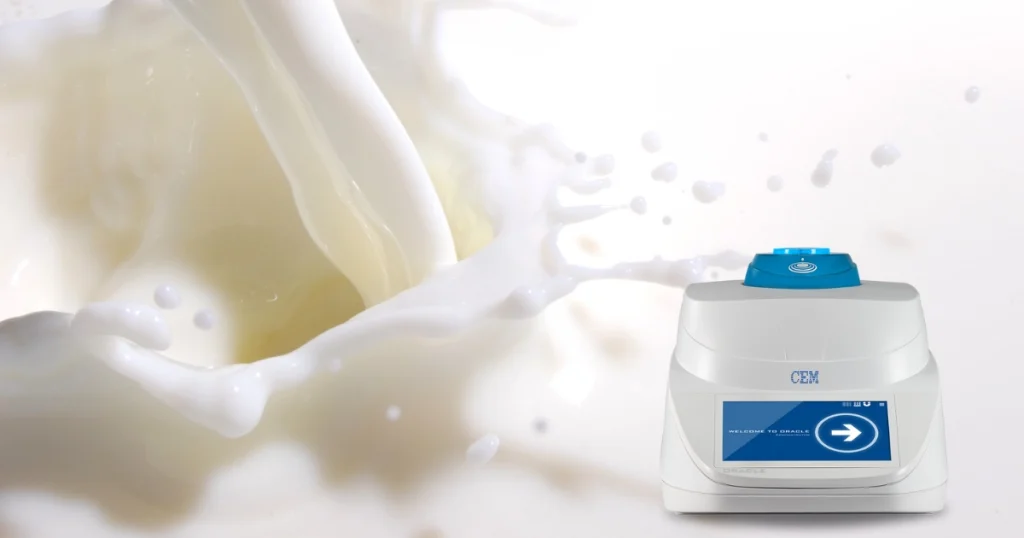
International guidance for determining total fat content in milk and milk-based products
Accurate fat determination is essential for dairy quality control, product formulation and nutritional analysis. Laboratories need reliable methods that can handle different dairy matrices while delivering consistent results. ISO 16756:2024 | IDF 259:2024 provides international guidance for determining total fat content in milk and milk-based products using time-domain nuclear magnetic resonance (TD-NMR) spectroscopy. The method offers an alternative to traditional solvent-based fat extraction. It enables laboratories to analyze a wide range of dairy products without developing matrix-specific calibrations.
What is ISO 16756 | IDF 259
ISO 16756:2024, also known as IDF 259:2024, was published in September 2024.
The standard provides guidance for applying low-resolution nuclear magnetic resonance (NMR) spectroscopy to determine total fat content in milk and milk-based products.
It uses the Carr-Purcell-Meiboom-Gill (CPMG) pulse sequence to optimize the measurement response of fat molecules.
The method analyzes glycerolipids and produces fat results comparable to those obtained using conventional fat extraction techniques. This comparability is subject to the precision criteria defined in the standard.
Unlike many other rapid analytical techniques, the method does not require matrix-specific calibrations.
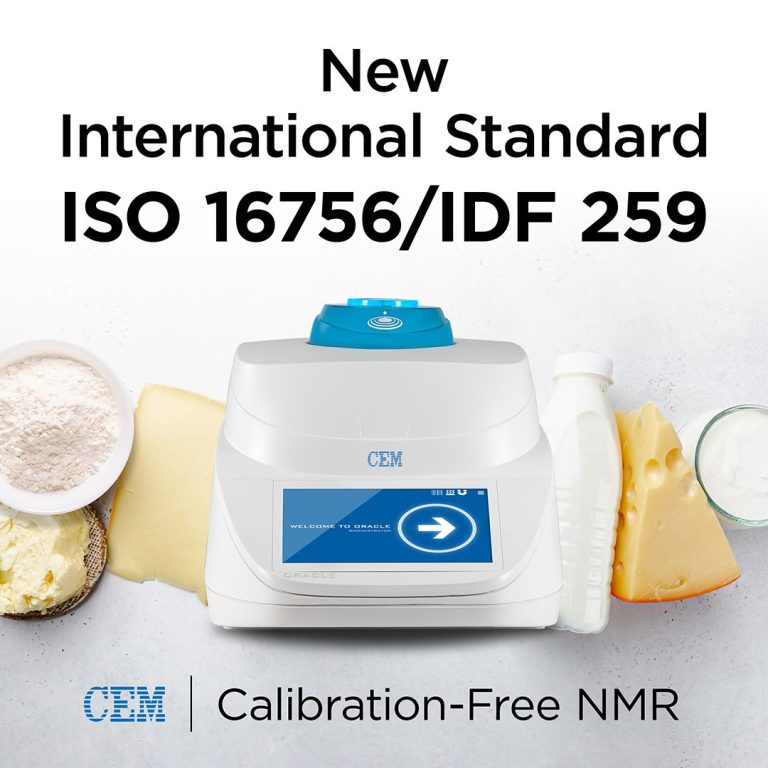
Which dairy products are covered by ISO 16756:2024?
The standard applies to milk and milk-based products from different animal species and geographical origins.
Examples include:
Milk and cream: products with different fat concentrations
Yogurt: fermented dairy products with varying compositions
Ice cream: complex dairy matrices containing fat, water and other ingredients
Cheese: products with different moisture and fat contents
Processed dairy products: manufactured dairy formulations
Dairy powders: dried milk and other powdered dairy products
The method is applicable to:
Dry samples with a moisture content of 10% or less
Liquid or wet samples that have been appropriately pre-dried
Samples with different viscosities, colors or particle sizes
The standard’s applicability is not limited by sample viscosity, color or particle size. However, laboratories must still follow the specified sample preparation and measurement requirements.
How does TD-NMR fat analysis work?
Time-domain nuclear magnetic resonance measures signals from hydrogen nuclei within a sample. Different sample components produce NMR signals with different relaxation characteristics. These differences allow analytical systems to distinguish relevant signals.
ISO 16756:2024 describes the application of the CPMG pulse sequence, which uses a series of radiofrequency pulses to measure signal decay. The sequence optimizes the response from fat molecules, allowing the determination of glycerolipids in dairy products.
Why use the CPMG pulse sequence?
Dairy products contain water, fat, proteins, carbohydrates and other components. These substances can contribute to the measured NMR signal. The CPMG approach uses differences in relaxation behavior to improve the specificity of fat determination.
When the method is applied under the conditions described in ISO 16756:2024, laboratories can obtain total fat results comparable to conventional extraction methods. An important advantage is that the method does not require matrix-specific calibrations.
Sample preparation for ISO 16756:2024
Appropriate sample preparation is essential for reliable TD-NMR fat determination.
The standard distinguishes between dry samples and samples containing appreciable amounts of water.
1. Moisture removal
Dry samples must have a moisture content of 10% or less. Liquid and wet dairy samples require pre-drying to remove appreciable water before NMR measurement.
This is important because water can interfere with the measurement of fat-related NMR signals. Laboratories can use suitable drying equipment, such as the CEM SMART 6 moisture analyzer, to prepare wet dairy samples.
The drying procedure must be appropriate for the sample matrix and validated analytical workflow.
2. Sample weighing
Accurate sample weighing is important for quantitative fat determination. Laboratories should use an appropriate analytical balance and follow the weighing requirements of the selected method.
3. Sample conditioning
The physical state and temperature of the fat can influence NMR measurements. Therefore, laboratories must apply suitable temperature conditioning before analysis. The exact conditions depend on the instrument, sample and analytical procedure.
4. Fat determination using TD-NMR
After preparation and conditioning, the sample is analyzed using a suitable TD-NMR instrument. The system measures the fat-related NMR response and calculates the fat content according to its validated measurement procedure. Laboratories should verify instrument performance and method precision using suitable quality control procedures.
Benefits of TD-NMR fat analysis in dairy laboratories
Solvent-free fat determination
Traditional gravimetric fat extraction methods commonly use organic solvents. TD-NMR offers an alternative that does not require solvent extraction during the fat measurement. This reduces solvent handling and the associated waste generated by the analytical procedure.
Reduced calibration requirements
Some rapid analytical techniques, including certain infrared methods, rely on product-specific calibration models. The CPMG TD-NMR approach described in ISO 16756:2024 does not require matrix-specific calibrations.
This can simplify analysis when laboratories work with multiple dairy products. However, routine instrument checks, performance verification and quality control remain important.
Analysis of different dairy matrices
The method covers milk, yogurt, cream, ice cream, cheese, dairy powders and processed dairy products. Its broad applicability makes it relevant for laboratories handling diverse sample types.
Faster routine analysis
TD-NMR can reduce the time required for the instrumental fat measurement compared with conventional extraction procedures. However, total turnaround time also depends on sample drying, conditioning and handling. Laboratories should consider the complete workflow when comparing analytical methods.
Non-destructive NMR measurement
NMR measurement itself does not require chemical extraction or destruction of the sample. However, sample drying and conditioning may change the original sample. Therefore, the complete procedure should not automatically be described as non-destructive.
TD-NMR versus traditional fat extraction methods
Conventional fat determination techniques, including gravimetric extraction methods, are widely used in dairy laboratories.
TD-NMR provides a different analytical approach.
| Aspect | TD-NMR using CPMG | Conventional solvent extraction |
|---|---|---|
| Measurement principle | Nuclear magnetic resonance response of glycerolipids | Extraction and gravimetric determination of fat |
| Organic solvents | Not required for NMR measurement | Generally required |
| Sample preparation | Drying and conditioning as applicable | Method-dependent preparation and extraction |
| Matrix-specific calibration | Not required under the ISO 16756 approach | Not typically based on instrumental calibration models |
| Analysis time | Rapid instrumental measurement | Often involves longer extraction procedures |
| Quality control | Instrument checks and method precision verification | Method-specific quality control |
Both approaches require appropriate sample preparation and analytical quality control. The selection of a suitable method depends on the sample type, laboratory requirements and applicable standards.
Laboratory instruments for ISO 16756:2024 fat analysis
Laboratories applying ISO 16756:2024 need suitable TD-NMR instrumentation and sample preparation equipment. The following instruments can support a dairy fat analysis workflow.

Microwave + infrared
SMART 6
Combines microwave and infrared energy for rapid moisture and total-solids determination. It is suitable for wet and dry products across a broad range of applications.

Direct total-fat analyzer
ORACLE
Uses TD-NMR to measure total fat across different food and feed matrices. It provides results in approximately 30 seconds without solvents or matrix-specific calibration.
Learn more about food applications
Discuss your application with our Xperts
Our Xperts are happy to discuss your application and help you find the right solution.
FAQ
What is ISO 16756 | IDF 259?
ISO 16756:2024 provides guidance for determining total fat content in milk and milk-based products using CPMG time-domain NMR spectroscopy.
Is ISO 16756:2024 the same as IDF 259:2024?
Yes. ISO 16756:2024 and IDF 259:2024 are corresponding designations for the international dairy fat analysis standard.
Can ISO 16756:2024 be used for cheese and yogurt?
Yes. The standard covers cheese, yogurt and other milk-based products. Wet samples require appropriate pre-drying before analysis.
Does ISO 16756:2024 require solvent extraction?
No. The described TD-NMR method determines fat without solvent extraction during the measurement procedure.
Does TD-NMR require calibration?
The method does not require matrix-specific calibrations. However, instrument calibration or standardization, performance verification and quality control must still follow the applicable procedures.
Can ORACLE and SMART 6 be used together?
Yes. SMART 6 can determine moisture and prepare suitable samples for subsequent fat measurement using ORACLE.
