English
 Dutch
 French


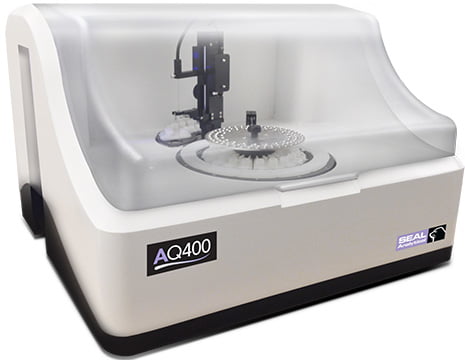
The SEAL AQ300 Discrete Analyzer is a compact instrument for automated colorimetric analysis of environmental samples. Designed for laboratories with limited bench space or smaller workloads, it offers the benefits of the AQ400 in a smaller format with lower sample throughput.
The AQ300 supports the determination of multiple parameters from the same sample, including ammonia, nitrate, nitrite, and phosphate. Its automated operation reduces manual sample handling and supports routine nutrient analysis in environmental laboratories.
How does the AQ300 discrete analyzer work?
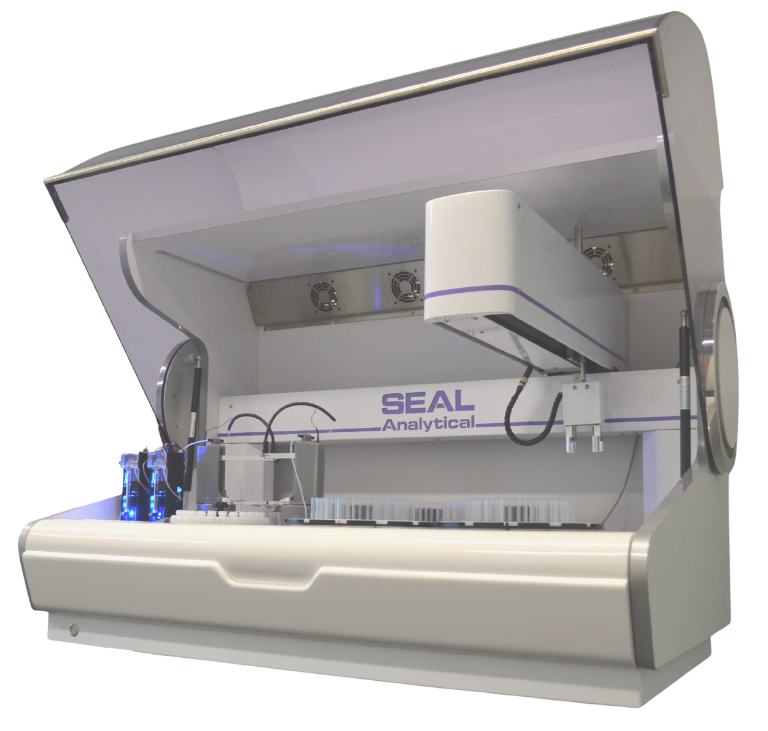
The AQ300 uses a robotic sampling arm and precision syringe to dispense samples and reagents into individual reaction wells. The solutions mix and incubate under controlled temperature conditions for a programmed reaction time. Once the reaction is complete, an aspiration probe transfers the solution into a dedicated 10 mm quartz cuvette.
A stationary optical system measures absorbance at the selected wavelength. The software then calculates the analyte concentration. The analyzer cleans the cuvette automatically between measurements, preparing it for the next analysis.
Reproducible measurements with a quartz cuvette
Unlike systems that measure absorbance directly in individual reaction wells, the AQ300 uses the same quartz cuvette for every measurement. The 10 mm optical path length and stationary detection system minimize variability associated with differences between reaction vessels and detector alignment. This design supports sensitive measurements, low detection limits, and reproducible analytical results.
Automated workflows and reduced reagent consumption
The AQ300 automates standard preparation, sample dilution, background color correction, and sample spiking. Laboratories can schedule multiple parameters and perform unattended overnight runs. Additional samples can also be introduced after a run has started. SEAL discrete analyzers use 20–400 µL of reagent per test, depending on the analytical method. Onboard reagent cooling and reagent-level detection support extended analytical runs. The AQ software also supports quality control, sample scheduling, and data exchange with laboratory information management systems (LIMS).
Carryover prevention and automatic cleaning
The AQ300 uses a traveling probe washer to clean the sampling probe before movement between positions. A stationary wash bath provides additional cleaning during the analytical process. After each absorbance measurement, alternating high-speed rinses of deionized water and air clean the quartz cuvette. These cleaning mechanisms minimize carryover and cross-contamination during multi-parameter analysis.
Nitrate and nitrite analysis with cadmium reduction
The AQ300 supports nitrate and nitrite determination using cadmium reduction and other colorimetric reduction methods. A dedicated cadmium coil reduces nitrate before colorimetric measurement. The system directs the relevant sample and buffer solutions through the coil, while other tests bypass it. Automatic in-line regeneration of the cadmium coil reduces manual maintenance requirements.
Available methods and applications
The AQ300 supports a wide range of colorimetric methods for environmental and agricultural analysis.
Available methods include:
- Alkalinity
- Ammonia
- Chloride
- Cyanide
- Nitrate and nitrite
- Phenolics
- Orthophosphate
- Total phosphorus
- Silicate
- Sulfate
- Total Kjeldahl nitrogen (TKN)
Applications include drinking water, wastewater, seawater, and prepared soil extract analysis.
Certain methods, including total phosphorus and TKN, require appropriate sample digestion before analysis. Analytical ranges and detection limits depend on the selected method.